Visar inlägg med etikett personal. Visa alla inlägg

2014-08-23

When Chernobyl Came to Sweden

I believe that I may refer to many of you, my readers, as friends that I have not yet met, because according to the Blogger statistics, I can see that many of you are returning to this place and that some of you have even used the information here as a source of reference (this honors me), so I hope that the reason why you keep on coming here is that you find my blog interesting and resourceful, or more important - that you find the topic of Chernobyl interesting. 

Should you have any questions on any of the subjects brought up in this blog or anything related to the Chernobyl disaster, please feel free to drop me a line at projekttjernobyl@gmail.com.

Anyway, enough ranting. Let's get down to business. 


As I have brought up in previous blog posts, such as in 86.04.26 - 01.23.49,  Breaking the News in Sweden, and
Breaking the news in Sweden - page 6, the Chernobyl disaster was initially exposed in Sweden. As the fallout was discovered and charted, it didn't take long for the public to get anxious and frightened of this matter and thus it didn't take very long for those in charge to come out with information about it all. At least it was due to November 1986. In my home, my parents probably took care of the information pamphlet and I don't remember even having a look at it, so I never knew it even existed.  About two years ago, a friend actually gave me a copy of that very pamphlet, so after having dedicated my two latest posts to recent events, it's now time for another walk down the memory lane.

Click on the headlines for full sized pictures. If you have a slow connection, please be patient, as the images are pretty large.

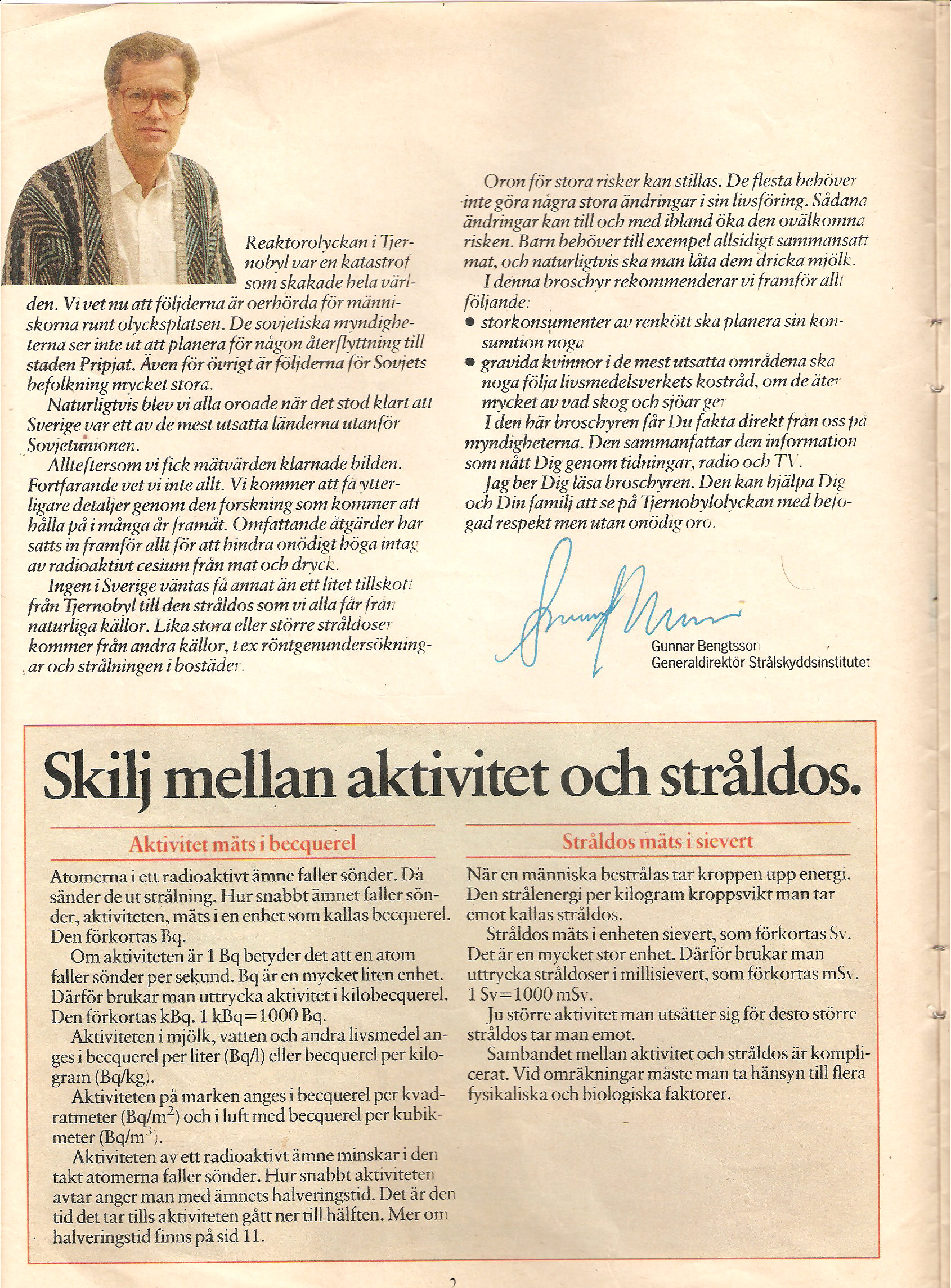


"The reactor accident in Chernobyl was a disaster that shook our entire world. We now know that the consequences for the people located nearby the site. The Soviet government doesn't seem to  be planning to return the evacuees of Pripyat back to their town. Even aside of this, the consequences for the people of the Soviet Union are very large. 
Of course, we were all alarmed, when it appeared as clear, that Sweden was one of the most exposed countries outside the Soviet Union. 
As we received the readings [of radiation], the image cleared. But still, we don't have all the information. We will receive further details through the research that will be performed many years ahead. Comprehensive actions have been taken in order to prevent unnecessarily high ingestion of radioactive caesium from food and drink.
No one in Sweden is expected to receive other than just a little addition, from Chernobyl, to that dose of radiation that we all receive from natural sources. Equal or larger doses come from other sources, such as x-ray examinations and the radiation of houses. 
The worries of big risks can be still. Most people do not have to make any big changes in their ways of life. Big changes may sometimes even increase the unwelcome risk. For example, children need a well composed food intake and of course they should be allowed to drink milk.
In this pamphlet we above all recommend the following:
*Large consumers of reindeer meat shall plan their consumption carefully. 
*Pregnant women in the most exposed areas shall most carefully follow the advice of the NFA, in case of consuming a lot of products from forests and lakes.
In this pamphlet, You get the facts directly from the government. It summarizes the information that has previously reached you through newspapers, radio and TV. 
I ask you to read this pamphlet. It may help You and Your family to look at the Chernobyl disaster with rightful respect, but without unnecessary fear."

These were the printed words of Gunnar Bengtsson, the director-general of the Swedish Radiation Protection Institute. I will not translate all of this 12 pages long pamphlet, but only summarize the content of the pages. Further down on page one, "Differ between activity and dose" you learn how to differ between radioactive activity and received doses: Activity is measured in bequerel (Bq) and received doses in sievert (Sv) [previously the equivalent unit was Roentgen]. The more activity you're exposed to, the higher dose you receive, naturally. Further, the text explain that the coherence between activity and dose is complicated. "Calculating it all, you need to take various physiological and biological factors into consideration."


A summary of the fallout in Sweden; information about the weather conditions of the time of the disaster; the levels of radiation and the attributes of the radioactive elements iodine-131, caesium-137, ctrontium-90 and plutonium-239.  Over Sweden, were spread a few grams of iodine-131, about 1,5 kilograms of caesium (5% of the total caesium fallout) and just a little plutonium. No strontium at all, it seems. Also it's pointed out that. "The five tons of plutonium that were spread throughout our atmosphere during the 50's and 60's, due to nuclear warhead detonations, is completely dominating our share of the Chernobyl fallout". All true, still admitted that radioactive atoms were everywhere. Please note that they were only atoms. 


The question is about whether people may still eat vegetables and drink milk provided in the food stores. A few days after the Chernobyl disaster, the Swedish government recommended farmers to keep their cows indoors in order to protect the cows' milk from getting contaminated by iodine-131.  The government decided on a maximum level regarding how high an amount of caesium-137 is acceptable in food and drink distributed to the public. The bags on the picture make a comparison between the amount of Bq of 2 kilograms of food purchased in Gävle and Malmö and the text inform that in both cases, the radioactivity of the groceries are far below the allowed maximum level. Only if you'd eat a lot of products coming from  of contaminated areas, you should have to restrict your intake of unchecked meat of reindeer, lamb, cheep and moose; a lot of freshwater fish and a lot of mushroom and berries from the forests.

Guidelines for activity in foodstuff

This piece of text explains that the goal of the NFA is to keep the levels of food contamination to an equivalent of a maximum of 1 mSv received per year. 1 mSv gives 75 000 Bq of caesium-137 or 50 000 of the less frequented caesium-134. However, the total received dose is not supposed to exceed 5 mSv per year, so you can see there is quite a margin there. 
Completing information, "Examination of foodstuff" tells about how the process of checking foodstuff was carried out.


Here it's stated that different kinds of foodstuff has absorbed different amounts of radiation. The amounts vary with foods and area and again it is assured that the levels are below the recommended, and repeated that you should not eat a lot of freshwater fish, meat from reindeer, lamb and cheep or mushroom or berries growing in the wild. 

Does it seem like the Swedish government was trying too hard in order to calm the citizens of the country? Actually they didn't try hard enough, because still to this day there are Swedes who fear the Chernobyl fallout. 

This you can do by yourself 

If you're hunter, fisher or someone who likes to collect mushroom and berries from the forest, here's information of where to turn if you're insecure whether your area is safe. 


Shows a chart of how local foodstuff has been affected by radiation. 
Water: nothing significant. Left to right: 

Milk: some of the caesium is transferred to the milk as cows cover large areas when eating grass.

Wild berries and mushroom:  grow on grounds poor of nutrition, are thus more prone to pick up caesium than their fertilized equivalencies.

Plants: meaning crop, potato and vegetables that are growing on fertilized, calcium enriched, grounds only take up a small part of the caesium.

Meat: in some cases levels over the recommended have been discovered. Pigs eat fodder containing a small amount of caesium, thus pigs' meat has low radioactivity. Meat from lamb and cheep from contaminated areas may contain very high amounts of caesium as they feed on growth close to ground surface. 

Reindeer and game: Move around contaminated areas and find their food on similar places as the above. 

"The amount of caesium an animal ingests, will in time be secreted from the body. Half of the amount is gone in 1-2 months. The amount of caesium in an animal is thus determined how much caesium it ingests and how much that is secreted" - And the metabolism plays a role as well, just as for us humans. 

Fish: Sea fish have been affected to a barely notable extent. In lakes and rivers suffering the heaviest fallout, there are locally levels exceeding the recommended. Algae and plankton have taken up radioactive substances. As fish eat these things, and as fish have a very low metabolism, the local problems may thus remain for years.


"In some cases significant amounts of radioactive stuff were collected from the [Chernobyl] fallout, in filters of large airflows, for example in industrial facilities, and large office complexes and housings.
Changing those filters, the normal protection used against dust and small particles is enough in order of protection"
Concerning sludge from sewage treatment facilities, there has been raised levels detected, but you can still work in the sludge for a few hours a day, without any increased threat to your health.

How our health is affected

About how large amounts of radiation may cause cancer damage on fetus and infants, including matter of mutation, but that no one in Sweden has to worry about that. 


Every number that you read is measured in mSv/year.
Shows how much radiation we receive from cosmos and our sun; the natural decay of the ground; our bodies; from radon in houses (!); in hospitals; other artificial sources and... After Chernobyl: The summary is that we in Sweden got an extra 0,3 mSv per year, including the food, which was people's main fear at the time. It also repeats that you may control your intake of foodstuff and thus regulated the amount of the caesium intake. 


Remember that this pamphlet was written and published when there was still not much information concerning the full picture. Please search the tags for more detailed references. 

"According to reports from the Soviet Union, technicians performed an experiment the night between the 25th and 26th of April 1986, at the 4th reactor of Chernobyl. This was due to the yearly inspection of the reactor. As the reactor was on low effect, they performed a test with an electric generator.
Those performing the test violated the safety precautions. Systems normally supposed to stop the reactor is case of error had been disconnected. The result was that they lost control of the reactor.
The reactor went wild and a few moments later, too hot steam had accumulated. The pressure caused the reactor hearth to explode. Explosions destroyed the reactor building. Parts of the destroyed hearth were [by the explosion] launched 1200 meters into the sky. The most of the parts landed close to the reactor. 
Reactors of this type contain graphite. The graphite caught fire. The graphite-fire spread even more radioactive substances to the envornments. Only after ten days the fire and emissions were under control. It's been calculated that a few percents of the total contents of the reactor were committed into the air. The wrecked reactor is currently being covered in concrete. 
According to the Russian investigation of the accident the disaster was caused by several violations of security. The fast and violent was connected to the construction of the reactor. Nuclear Power Plants with reactors of this construction only exist in the Soviet Union. I most other countries, the reactors are confines in buildings of concrete and steel.
The consequences concerning Soviet has been immense. About 30 people have died. Over 200 have been severely damaged by radiation. Circa 135 000 people have been forced to leave their homes. Unknown, whether they'll be able to move back.
The accident will also have long term effects. They're counting on an extra of ten thousands of deaths the coming 50 years."

Map

Shows how the radioactive wind blew through Europe between the 26th oh April and 1st of May 1986.


The RPI and the Swedish Defence Research Agency put up a number of radiation measuring instruments in order to receive  an early image of the damage done. 

More about half life 

Iodine-131: 8 days
Caesium.134: 2 years
Caesium-137: 30 years

The list based on potential threats to Sweden, due to the Chernobyl disaster, which is why they left out information concerning strontium-90 and plutonium-239.
If the summary of this pamphlet has left you with unanswered questions concerning radiation, I recommend that you to read those of my posts posts regarding effects of radiation:   About Radiation Pt1 ARS - Acute Radiation Syndrome1, About Radiation pt 2 - How it may affect the human body and About Radiation; part 3 - Closing up 


Page 12 - Our readiness for nuclear accidents

"The Rescue Services Agency  is leading and developing its services in the entire country, especially in areas where there are nuclear power plants. That is in the counties of Malmö, Kalmar, Halland and Uppsala. Around every Swedish nuclear power plant there is a 12-15 kilometers inner readiness zone. If something happens that causes large emissions of radioactive substances, the population within this zone will be alerted through sirens and telephones.
The sirens give the signal "Important message - listen to the radio". Information concerning what happened and what you're supposed to do should be given by the County Administration in radio P3.
The County Administration is controlling the Rescue Services Agency where the fire brigade, the police, the municipality, health care services and coastguards are included.
The Radiation Protection Institute and the nuclear inspection, that are state regulators, are a part of this orgnisation. They have an educated and trained organization that was the base of activity after Chernobyl.
The signal "Important message-listen to P3!" can be distributed in most cities and towns all over the country.
The signal is tested at 15:00 hrs the first Monday of March, June, September and December.
The accident in Chernobyl has showed that we need to increase our readiness for nuclear accidents in Sweden. Therefore the current readiness organization will be looked over, and a certain amount of readiness for nuclear accidents will be established in all counties. The nationwide radiation measuring system that already exist, will be expanded. There will be international agreements concerning a quick distribution of information, in cases of nuclear accidents."

The grey box on the top right of this last page, tells that the pamphlet is also available in English, German, French, Spanish, Polish, Serbo-Croatian, Greek, Arabic, Italian, Finnish, Turkish, Icelandic, Kurdish, Persian, Romanian, Tigrinya, Hungarian, Vietnamese  and in simplified Swedish.  No Russian? Well, those were the days of the cold war, weren't they. Lastly, on this 12th page, you are informed about where to turn if you have any ideas or questions. 

As you can see, the Swedes had no real reason to worry about the Chernobyl fallout, and thus the initial fear was quickly dealt with. Does it seem like the Swedish government was trying too hard in order to calm the citizens of the country? Actually they didn't try hard enough, because still to this day there are (a luckily enough very small amount of) Swedes who fear the Chernobyl fallout and who obviously feel "violated" by the fact that they had to be scared for a few days in May 1986, something which is shared with a number of Americans, as a small number of radioactive particles were detected in the atmosphere over Northern America. People who have nothing to fear often try to find something to be afraid of, whilst those who indeed have something to fear, tend to endure. 


2013-11-26

That is not dead, which can eternal lie

"I am aware of that this blog may be dying" read the beginning of a sentence in a comment recently posted as a response to my previous blog entry
  Yes, the speed of my project slowed down from that of a cheetah, to that of a sleeping tortoise, but no - it cannot die, not until it reaches its end and I am not done by far. 

It's not the first time I receive positive comments about my blog and research, but recent events have finally made me realize the importance of this project, not only for those who are interested in learning more about the disaster, its factors, aspects and consequences, but also for those who were there, fighting the battle against an invisible enemy and who are still fighting, now to be acknowledged as human beings. We need to make them aware of that they are not forgotten and I want to help by telling their story, for more people to gain knowledge on a closer level, not only limited to the pictures painted by mass media. I'm not after romance or tragedy - I need the truth to be told and and spread, and before that has been achieved I will not be able to rest. Even if I wanted to, I would not possibly be able to: Chernobyl doesn't leave me. It's always there, hiding in the background, even if I do not think about it; even during the long time during which my project was slumbering, never further away than just around the corner. 

Thus, I can reassure you all that neither the blog nor the project are dying. You can not be expecting me to write here every day, or even several times a week, but you can be sure that I will write. This far, this blog has had over 45 000 views since its start. This means that over 45 000 times people have had a reason to read my writings and I want that number to increase, because for every time it (hopefully) means that someone has become a little more aware.

Finally: I'm not a musician, but last summer I recorded the following track, about that dreadful morning of April 26th, 1986:  


2011-12-22

Those Who Are Forgotten

Now there was an absense again, this time due to me spending time in Ukraine. In Kiev to be more precise. This time I could for known reasons not visit the Zone as it's currently close to impossible to get a permission to enter. It's funny, because the moment I return to Sweden I am greeted by a message concerning that the Zone seems to be open again and there's a tourist trip areanged for January 2012. I do not know what to believe anymore. Right now it seems  that all business regarding the zone can be labeled a travesty. 

In Kiev, there are a for me still unknown number of Chernobyl memorial monuments situated in different areas of the city. I must admit that I only know of one of them, which seems to be the most recent one created but before my journey I was determined that I would pay it a visit. 

This statue of a worn out firefighter is situated at the Kruglouniversistetska no. 22. This street is a fairly anonymous stroll from the main street of Khreshatik in the centre of Kiev and a place you can be sure to find empty if you go there after 17:00 in the afternoon. As I find it in the early evening on the 15th of December, after a short walk up a long slope it's already dark as night and the street is empty. Further down this hill, stand policemen watching over the traffic, but the firefighter sits all alone. In the darkness, the sense of solitude is enhanced and I cannot stop the feeling of sadness almost overwhelming me, but still I do not go very close. Instead I keep my distance, just watching. Thinking. 

In April, previously this year, the firefighter was surrounded by flowers left there by visitors and the time was appropriate - 25 years after the disaster various acts of memorial were held in Kiev, but now the piece of rock on which he sits is clean and empty. That in itself, to me is a reminder of how easy people forget. However I did not forget that I six months ago decided to find this place and bring flowers to pay my respect for those who saved the world. This evening I have no flowers but I return in the morning, having bought one single white rose from a lady at the metro station "Universitet". In the wind and stinging rain I extract the carefully wrapped flower and place it with the firefighter. It takes a long time. Water is dripping from his ears and from my eyes and I find it difficult to leave.

Four days later I am back in Gothenburg, reading my messages. The same author stating that the Zone seems to be open again, informs me that of the last firefighter helmet, there has been a find. The heavily contaminated inlet of this helmet has been removed and left it on a bucket outside the very entrance to the Pripyat hospital. On a personal note I do not know whether to find this to be irony or just a downright mockery and disrespect. 

2011-11-29

Chernobyl in Space?

At the opening of the exhibition.
I may have mentioned this before but some time ago I was asked if I'll ever make comics about Chernobyl. My answer was no, because in the case of Chernobyl it is of my opinion that reality exceeds any form of fiction anyone could ever think up spinning off from the Chernobyl disaster and its consequenses.

However I was a few months ago invited to participate in a comics festival/exhibition in Gothenburg and immediately realized that I needed some new material - I didn't feel like I could just be satisfied by throuwing in an amout of old things - and thus I started drawing pages for my long-term science fiction project Methatron II, after a script I haven't yet written. It all ended up like a re-run of the prelude of the Chernobyl disaster. There was absolutely no thought behind it - it just happened. Or maybe it happened because I had just finished writing a scientific article concerning reactor powered spacecraft. -Who knows?

In any case, here are the pages I am refering to, and to that I will just add that it remains clear that even if I can be removed from Chernobyl, Chernobyl obviously can't be removed from me.


2011-10-14

Chernobyl Nuclear Power Plant under construction, and the closing of the Zone II

Do you remember this image? In August I wrote a brief note about it. 


Since then I haven't become much wiser concerning exactly what these cylinders are, although a theory was that they might be cooling towers, which isn't very likely. Maybe storages. It's the closest guess I can make.

The other day I stumbled upon a satellite photo of the ChNPP on which I could locate the six cylinders. I've 

circled them in red, as you can see. According to this photo they don't even seem to be there anymore, but my eyes may play tricks on me.


When in Chernobyl, I didn't get to see more than a brief view of the NPP and came nowhere near these buildings, and now the NPP all another no-go area of the Zone. Tourists may see the 4th block and Sarcophagus from a distance but that's it.


This leads me to tell you further about the closing of the Zone. For a long time I kept quiet about it because I thought that the fewer people who visit the Zone, the better, but I do realize that me keeping my mouth shut means nothing - everyone who wants to enter the Zone will find a way. 


Many people have asked me about the closure since I made the above post; "Why?" and I asked myself the same as it as far as I'm concerned was a highly illogical thing by the Ukrainian government to do after having opened up the exclusion zone only 6 months due to closing it again. 


If the Zone was really closed, all those websites offering Chernobyl tours, would have called off their services, wouldn't they? It was said that only journalists and scientists could enter the Zone, and I bought it too, but only a short time after, I found out what was really the fact, and the fact is that it's all getting organized in a way that is supposed to make it seem harder to get into the Zone but will make people pay more to get there by having to go through intermediaries. From this view it's truly harder to get to the Zone as there is now more bureaucracy involved, but I've read reports from various people who have been there since the announcement of the closure so it seems that the Zone is far from closed. 


2011-10-12

Food for thought?

Official photo: Helicopter flying towards the burning 4th block.
Being questioned, the Chernobyl officials first refused to admit any flaws with the RBMK reactors - those had been around for years. They didn't know better.

Thus the blame was put on the officials and workers who were supposed to be well familiar with the rules. They were. But they weren't aware of the over ten accidents in other Soviet reactors that was kept secret by the government. So they knew the rules but not the risks because nobody told them of what had happened or what could happen. 

How can you run a new machine properly without first having read the manual, and if you run this machine for someone else who wants you to do a perfect job and who has the manual but won't give it to you, how do they expect you to perform correctly?

This all looks very simple, doesn't it? But it isn't. It just manifests the entire complexity of the Chernobyl affair. I wonder if we will ever find out the truth.

2011-09-19

Exhibition Dismantled

Panorama of my exhibition by L-G Johansson.
Yesterday afternoon I, assisted by my brother, disassembled my exhibition at the Gothenburg City Library. There was nothing special about it - we spent approximately 45 minutes climbing around, taking down the posters and cleaning the walls from super extra strong double adhesive tape and then that was it. It felt both a little sad, and like something of a relieve to have gotten it over with: On one hand it will feel strange to visit the library without marching right away to the spot and attend to it, but on the other hand it feels good not to go there every day worrying about theft or vandalism. 

Here are some notes left in the guestbook: 

"Awesome you to spread the truth! It's just the way to do it!"
"A beautiful and frightening exhibition. Thanks for making it!"
"A bloody awesome excellent exhibition, I like the photos and all the drawings!" 
"Beautiful exhibition! I'm really happy that such subjects are taken up today. I'd love to find out more!"
"Thanks for a pleasant exhibition. It would have been nice, though, if it all had been placed so that someone who's 161 cm tall could read the upper parts too. Suggestion: Move the four lower images to the side and move down the larger "posters'." 
"Good to see a Chernobyl exhibition the day before CBRN education. Thanks!" 
"Thought provoking! Strong images!" 
"Om nom nom. Reactor." 
The story continues... 

2011-08-30

Rounding up the Swedes

It is obvious that my presense is required at the exhibition. Having caught a cold, I could not be there this afternoon as planned, but two friends who visited the exhibition told me about the mess that had occurred; the banner detaching from the wall and the library personnel loading a lot of junk around it all. As this came to my knowledge late in the afternoon, of course I had no choice but to go there and take care of these nuisances. 

The disturbances were easily gotten rid of, and I could then find the peace to enjoy the flowers sent to the exhibition. Yes that's right, someone actually sent flowers to the exhibition all the way from Stockholm and it was a very pleasant surprise. There was a card attached as well, with a greeting reading "Hoping for a radiating success!"

A few days ago, I was made aware of that some have gotten the impression that this blog was only due to the exhibition and that I would quit writing after that and I admit that I might have stated something that may have encouraged such impressions, but the truth is that... it's not true: I will keep on posting in this blog for as long as there are things to be told.


Hans Blix visiting all-Union Scientific Center of Radioactive Medicine


Some days ago, I decided to write a letter to Hans Blix. Mr. Blix was the chairman of the International Atomic Energy Agency between 1981 and 1997 and the first foreigner to visit Chernobyl after the disaster ( as early as in May 1986) where he would discuss the matter of safer nuclear power in the Soviet Union. 

I figured that Hans Blix may be able to answer some of my questions, also because of knowing the political climate of that period (unfortunately politics are inevitable even in this matter) and when a friend actually presented me with proper contact information to Hans Blix, I realized that I would not have to go through with the usual "journalist's routine" but could rather get on straight ahead. 

Blix also met Valery Legasov, the nuclear chemist send from Moscow to investigate the Chernobyl accident (who committed suicide on the anniversary of the disaster in 1988). Also Legasov is an important key in the Chernobyl  jigzaw  and there are details that haven't been written, so when and if I manage to establish contact with Hans Blix, now 84 years old, there are chances that it'll all mean an important deal to my research.

A few weeks ago I contacted the nuclear power plant in Forsmark, who first discovered the Chernobyl fallout, asking to get in touch with someone who worked at the NPP at the time. I received a name and an address. Anders Markgren, assistant information officer at the Forsmark NPP, is now also on my list.


As you can see, I have no intentions of ceasing this.
Today, my father asked me if anyone closely involved ever wrote anything objective and truthful about the disaster. I could only mention Valery Legasov and say that it's possible that his writings are the closest to the truth as we can get, but he is -unfortunately- dead and dead men doesn't answer questions. 
I intend to find out how close to the truth you can get 25 years later. 


[Note: The photo is from profimedia.si]


2011-08-28

The day has come...

Making a case for all the stuff to bring...
Well, not quite yet, but close enough. 

This afternoon I returned after a few days out of town to take care of the final preparations and tomorrow morning I will get up at 6 am (that's why I probably shouldn't drink the insane amounts of strong coffee that I'm ingesting as I type this) , be at the City Library at 8:00 and set up things because at 10:00 my exhibition finally opens.

What else can I say about it? You already know that it's been a dear work to me and that it will not end with this. There's more to Chernobyl than I can put on a wall. I will continue with my research until it can take me no further, but something tells me, and I think I've said this before, that I've barely began to scratch the surface.

If you have the chance to visit the exhibition, I wish you a warm welcome.

2011-08-24

Pripyat - A Brief Subjective Perspective of Home

Rannebergen and Pripyat, or the other way around?
I travel a lot. Or at least I try to do it as much as I can, because having spent over 25 years in the same vincinity started to take its toll already several years ago. My family moved to Mölndal, the nearest town south of Gothenburg, when I was five years old and thus I grew up in the surroundings of Gothenburg.

When I left my parents' home to live on my own, I ended up in a concrete block, where I still reside. Being a student at that time, I never found the time to make myself a proper home, but this was a place to study and to sleep. Eventually I came to greatly dislike this place, spare for in summer time, because in the summer, it's truly beautiful here with the forest, lakes and ..swamps. If you bother to walk further into the woods.

I always loved traveling and as soon as I was old enough to go on my own, I did. In the beginning I would return to my home with a sense of excitement and joy from the new impressions, because of that home is sweet home. August 2003 was the last time I sensed that feeling. Nothing happened - time just caught up with me and I realized I didn't like it here and since then I've returned to this city, from every journey, not thinking "home sweet home" but rather "not again..."

My return from Ukraine and the Zone in May this year happened during a rainy night. It was dark and cloudy. The next day, when visiting my mother, I saw the wind tear the trees just like that day in the Jupiter plant. There was no thunder but it was almost the same. Or was it just that my mind hadn't left the Zone? It felt surprisingly nice to be back. A few days later, it struck me why. I was on the bus, approaching my block on the hill, almost covered by trees and growth, and I was made aware of how it all resembled Pripyat. Whilst still in Ukraine, I published this video. One friend gave his feedback: "It looks like Angered" (Rannebergen is in the Angered region) and another one said "I thought it was Mölndal" but not until weeks later I understood what they meant.

What happened to me in the Zone?
Did anything at all happen? If so, I didn't notice it. It felt quite natural for me to be there, especially in Pripyat. There was nothing threatening about these old, decaying buildings; nothing fearsome. On the contrary, it was all very peaceful. In my  travel report I've mentioned how I deliberately avoided sticking to our group. This was because that I wanted to explore and examine the Zone without any cameras clicking around me all the time. I wanted to feel it. And I did. Through each building I went through on my own, images became clearer. But always interrupted. We must move on.

And that's another reason why I must get back there. I haven't seen half of it. And every day that I return to my concrete block on this hill, I'm reminded of it.