Visar inlägg med etikett radioactivity. Visa alla inlägg

2014-08-23

When Chernobyl Came to Sweden

I believe that I may refer to many of you, my readers, as friends that I have not yet met, because according to the Blogger statistics, I can see that many of you are returning to this place and that some of you have even used the information here as a source of reference (this honors me), so I hope that the reason why you keep on coming here is that you find my blog interesting and resourceful, or more important - that you find the topic of Chernobyl interesting. 

Should you have any questions on any of the subjects brought up in this blog or anything related to the Chernobyl disaster, please feel free to drop me a line at projekttjernobyl@gmail.com.

Anyway, enough ranting. Let's get down to business. 


As I have brought up in previous blog posts, such as in 86.04.26 - 01.23.49,  Breaking the News in Sweden, and
Breaking the news in Sweden - page 6, the Chernobyl disaster was initially exposed in Sweden. As the fallout was discovered and charted, it didn't take long for the public to get anxious and frightened of this matter and thus it didn't take very long for those in charge to come out with information about it all. At least it was due to November 1986. In my home, my parents probably took care of the information pamphlet and I don't remember even having a look at it, so I never knew it even existed.  About two years ago, a friend actually gave me a copy of that very pamphlet, so after having dedicated my two latest posts to recent events, it's now time for another walk down the memory lane.

Click on the headlines for full sized pictures. If you have a slow connection, please be patient, as the images are pretty large.

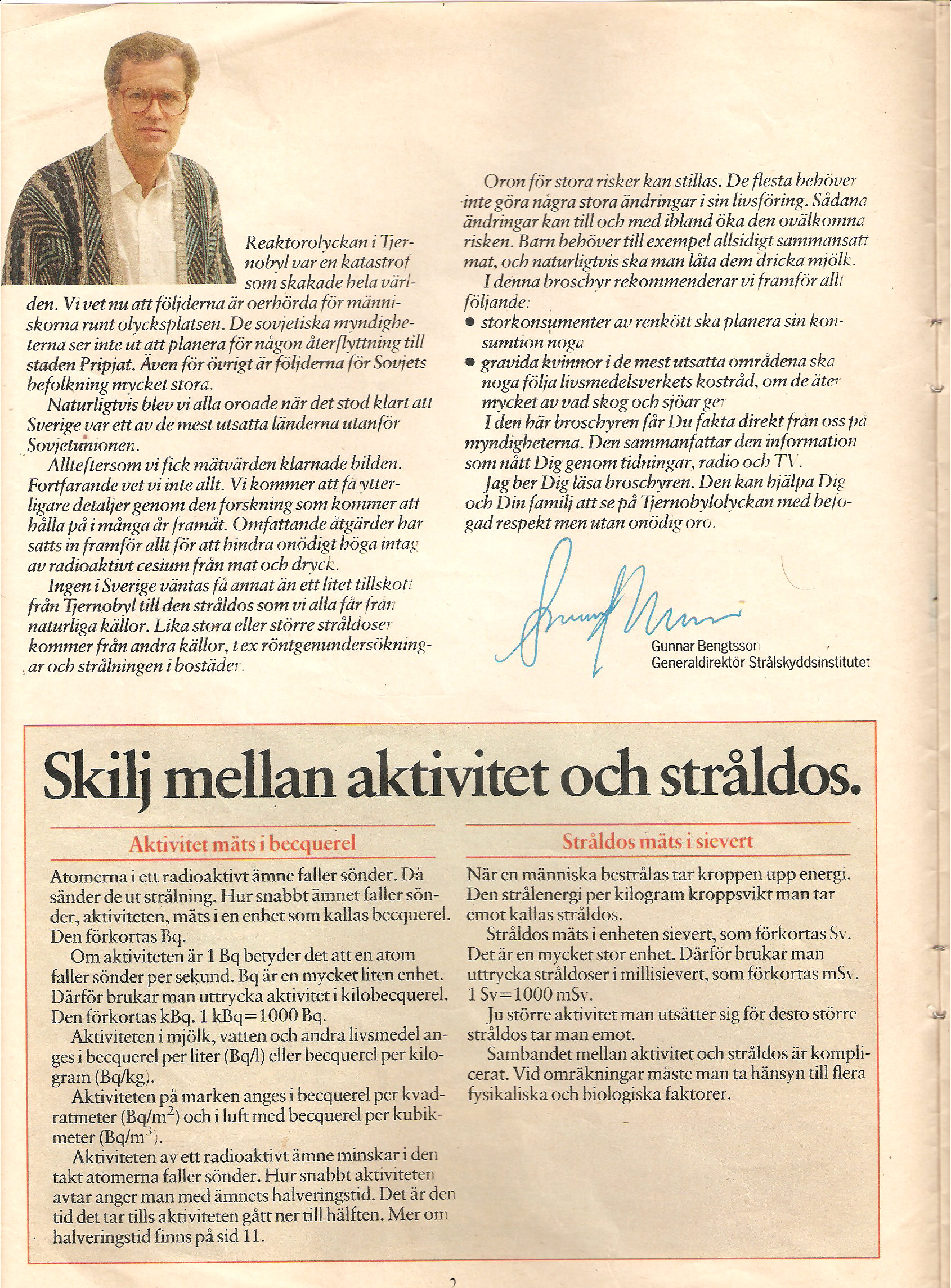


"The reactor accident in Chernobyl was a disaster that shook our entire world. We now know that the consequences for the people located nearby the site. The Soviet government doesn't seem to  be planning to return the evacuees of Pripyat back to their town. Even aside of this, the consequences for the people of the Soviet Union are very large. 
Of course, we were all alarmed, when it appeared as clear, that Sweden was one of the most exposed countries outside the Soviet Union. 
As we received the readings [of radiation], the image cleared. But still, we don't have all the information. We will receive further details through the research that will be performed many years ahead. Comprehensive actions have been taken in order to prevent unnecessarily high ingestion of radioactive caesium from food and drink.
No one in Sweden is expected to receive other than just a little addition, from Chernobyl, to that dose of radiation that we all receive from natural sources. Equal or larger doses come from other sources, such as x-ray examinations and the radiation of houses. 
The worries of big risks can be still. Most people do not have to make any big changes in their ways of life. Big changes may sometimes even increase the unwelcome risk. For example, children need a well composed food intake and of course they should be allowed to drink milk.
In this pamphlet we above all recommend the following:
*Large consumers of reindeer meat shall plan their consumption carefully. 
*Pregnant women in the most exposed areas shall most carefully follow the advice of the NFA, in case of consuming a lot of products from forests and lakes.
In this pamphlet, You get the facts directly from the government. It summarizes the information that has previously reached you through newspapers, radio and TV. 
I ask you to read this pamphlet. It may help You and Your family to look at the Chernobyl disaster with rightful respect, but without unnecessary fear."

These were the printed words of Gunnar Bengtsson, the director-general of the Swedish Radiation Protection Institute. I will not translate all of this 12 pages long pamphlet, but only summarize the content of the pages. Further down on page one, "Differ between activity and dose" you learn how to differ between radioactive activity and received doses: Activity is measured in bequerel (Bq) and received doses in sievert (Sv) [previously the equivalent unit was Roentgen]. The more activity you're exposed to, the higher dose you receive, naturally. Further, the text explain that the coherence between activity and dose is complicated. "Calculating it all, you need to take various physiological and biological factors into consideration."


A summary of the fallout in Sweden; information about the weather conditions of the time of the disaster; the levels of radiation and the attributes of the radioactive elements iodine-131, caesium-137, ctrontium-90 and plutonium-239.  Over Sweden, were spread a few grams of iodine-131, about 1,5 kilograms of caesium (5% of the total caesium fallout) and just a little plutonium. No strontium at all, it seems. Also it's pointed out that. "The five tons of plutonium that were spread throughout our atmosphere during the 50's and 60's, due to nuclear warhead detonations, is completely dominating our share of the Chernobyl fallout". All true, still admitted that radioactive atoms were everywhere. Please note that they were only atoms. 


The question is about whether people may still eat vegetables and drink milk provided in the food stores. A few days after the Chernobyl disaster, the Swedish government recommended farmers to keep their cows indoors in order to protect the cows' milk from getting contaminated by iodine-131.  The government decided on a maximum level regarding how high an amount of caesium-137 is acceptable in food and drink distributed to the public. The bags on the picture make a comparison between the amount of Bq of 2 kilograms of food purchased in Gävle and Malmö and the text inform that in both cases, the radioactivity of the groceries are far below the allowed maximum level. Only if you'd eat a lot of products coming from  of contaminated areas, you should have to restrict your intake of unchecked meat of reindeer, lamb, cheep and moose; a lot of freshwater fish and a lot of mushroom and berries from the forests.

Guidelines for activity in foodstuff

This piece of text explains that the goal of the NFA is to keep the levels of food contamination to an equivalent of a maximum of 1 mSv received per year. 1 mSv gives 75 000 Bq of caesium-137 or 50 000 of the less frequented caesium-134. However, the total received dose is not supposed to exceed 5 mSv per year, so you can see there is quite a margin there. 
Completing information, "Examination of foodstuff" tells about how the process of checking foodstuff was carried out.


Here it's stated that different kinds of foodstuff has absorbed different amounts of radiation. The amounts vary with foods and area and again it is assured that the levels are below the recommended, and repeated that you should not eat a lot of freshwater fish, meat from reindeer, lamb and cheep or mushroom or berries growing in the wild. 

Does it seem like the Swedish government was trying too hard in order to calm the citizens of the country? Actually they didn't try hard enough, because still to this day there are Swedes who fear the Chernobyl fallout. 

This you can do by yourself 

If you're hunter, fisher or someone who likes to collect mushroom and berries from the forest, here's information of where to turn if you're insecure whether your area is safe. 


Shows a chart of how local foodstuff has been affected by radiation. 
Water: nothing significant. Left to right: 

Milk: some of the caesium is transferred to the milk as cows cover large areas when eating grass.

Wild berries and mushroom:  grow on grounds poor of nutrition, are thus more prone to pick up caesium than their fertilized equivalencies.

Plants: meaning crop, potato and vegetables that are growing on fertilized, calcium enriched, grounds only take up a small part of the caesium.

Meat: in some cases levels over the recommended have been discovered. Pigs eat fodder containing a small amount of caesium, thus pigs' meat has low radioactivity. Meat from lamb and cheep from contaminated areas may contain very high amounts of caesium as they feed on growth close to ground surface. 

Reindeer and game: Move around contaminated areas and find their food on similar places as the above. 

"The amount of caesium an animal ingests, will in time be secreted from the body. Half of the amount is gone in 1-2 months. The amount of caesium in an animal is thus determined how much caesium it ingests and how much that is secreted" - And the metabolism plays a role as well, just as for us humans. 

Fish: Sea fish have been affected to a barely notable extent. In lakes and rivers suffering the heaviest fallout, there are locally levels exceeding the recommended. Algae and plankton have taken up radioactive substances. As fish eat these things, and as fish have a very low metabolism, the local problems may thus remain for years.


"In some cases significant amounts of radioactive stuff were collected from the [Chernobyl] fallout, in filters of large airflows, for example in industrial facilities, and large office complexes and housings.
Changing those filters, the normal protection used against dust and small particles is enough in order of protection"
Concerning sludge from sewage treatment facilities, there has been raised levels detected, but you can still work in the sludge for a few hours a day, without any increased threat to your health.

How our health is affected

About how large amounts of radiation may cause cancer damage on fetus and infants, including matter of mutation, but that no one in Sweden has to worry about that. 


Every number that you read is measured in mSv/year.
Shows how much radiation we receive from cosmos and our sun; the natural decay of the ground; our bodies; from radon in houses (!); in hospitals; other artificial sources and... After Chernobyl: The summary is that we in Sweden got an extra 0,3 mSv per year, including the food, which was people's main fear at the time. It also repeats that you may control your intake of foodstuff and thus regulated the amount of the caesium intake. 


Remember that this pamphlet was written and published when there was still not much information concerning the full picture. Please search the tags for more detailed references. 

"According to reports from the Soviet Union, technicians performed an experiment the night between the 25th and 26th of April 1986, at the 4th reactor of Chernobyl. This was due to the yearly inspection of the reactor. As the reactor was on low effect, they performed a test with an electric generator.
Those performing the test violated the safety precautions. Systems normally supposed to stop the reactor is case of error had been disconnected. The result was that they lost control of the reactor.
The reactor went wild and a few moments later, too hot steam had accumulated. The pressure caused the reactor hearth to explode. Explosions destroyed the reactor building. Parts of the destroyed hearth were [by the explosion] launched 1200 meters into the sky. The most of the parts landed close to the reactor. 
Reactors of this type contain graphite. The graphite caught fire. The graphite-fire spread even more radioactive substances to the envornments. Only after ten days the fire and emissions were under control. It's been calculated that a few percents of the total contents of the reactor were committed into the air. The wrecked reactor is currently being covered in concrete. 
According to the Russian investigation of the accident the disaster was caused by several violations of security. The fast and violent was connected to the construction of the reactor. Nuclear Power Plants with reactors of this construction only exist in the Soviet Union. I most other countries, the reactors are confines in buildings of concrete and steel.
The consequences concerning Soviet has been immense. About 30 people have died. Over 200 have been severely damaged by radiation. Circa 135 000 people have been forced to leave their homes. Unknown, whether they'll be able to move back.
The accident will also have long term effects. They're counting on an extra of ten thousands of deaths the coming 50 years."

Map

Shows how the radioactive wind blew through Europe between the 26th oh April and 1st of May 1986.


The RPI and the Swedish Defence Research Agency put up a number of radiation measuring instruments in order to receive  an early image of the damage done. 

More about half life 

Iodine-131: 8 days
Caesium.134: 2 years
Caesium-137: 30 years

The list based on potential threats to Sweden, due to the Chernobyl disaster, which is why they left out information concerning strontium-90 and plutonium-239.
If the summary of this pamphlet has left you with unanswered questions concerning radiation, I recommend that you to read those of my posts posts regarding effects of radiation:   About Radiation Pt1 ARS - Acute Radiation Syndrome1, About Radiation pt 2 - How it may affect the human body and About Radiation; part 3 - Closing up 


Page 12 - Our readiness for nuclear accidents

"The Rescue Services Agency  is leading and developing its services in the entire country, especially in areas where there are nuclear power plants. That is in the counties of Malmö, Kalmar, Halland and Uppsala. Around every Swedish nuclear power plant there is a 12-15 kilometers inner readiness zone. If something happens that causes large emissions of radioactive substances, the population within this zone will be alerted through sirens and telephones.
The sirens give the signal "Important message - listen to the radio". Information concerning what happened and what you're supposed to do should be given by the County Administration in radio P3.
The County Administration is controlling the Rescue Services Agency where the fire brigade, the police, the municipality, health care services and coastguards are included.
The Radiation Protection Institute and the nuclear inspection, that are state regulators, are a part of this orgnisation. They have an educated and trained organization that was the base of activity after Chernobyl.
The signal "Important message-listen to P3!" can be distributed in most cities and towns all over the country.
The signal is tested at 15:00 hrs the first Monday of March, June, September and December.
The accident in Chernobyl has showed that we need to increase our readiness for nuclear accidents in Sweden. Therefore the current readiness organization will be looked over, and a certain amount of readiness for nuclear accidents will be established in all counties. The nationwide radiation measuring system that already exist, will be expanded. There will be international agreements concerning a quick distribution of information, in cases of nuclear accidents."

The grey box on the top right of this last page, tells that the pamphlet is also available in English, German, French, Spanish, Polish, Serbo-Croatian, Greek, Arabic, Italian, Finnish, Turkish, Icelandic, Kurdish, Persian, Romanian, Tigrinya, Hungarian, Vietnamese  and in simplified Swedish.  No Russian? Well, those were the days of the cold war, weren't they. Lastly, on this 12th page, you are informed about where to turn if you have any ideas or questions. 

As you can see, the Swedes had no real reason to worry about the Chernobyl fallout, and thus the initial fear was quickly dealt with. Does it seem like the Swedish government was trying too hard in order to calm the citizens of the country? Actually they didn't try hard enough, because still to this day there are (a luckily enough very small amount of) Swedes who fear the Chernobyl fallout and who obviously feel "violated" by the fact that they had to be scared for a few days in May 1986, something which is shared with a number of Americans, as a small number of radioactive particles were detected in the atmosphere over Northern America. People who have nothing to fear often try to find something to be afraid of, whilst those who indeed have something to fear, tend to endure. 


2014-08-20

The Means of Mutation

Chernobyl forest winter time. On courtesy of bbc.co.uk
Is the exclusion zone a radioactive death trap or a haven for wildlife?
Performing a simple internet search on Chernobyl wildlife, you will undoubtedly find many article praising the Zone for its richness of species, but taking a closer look at it all, it is not at all what it seems. 

The popular idea of that the Chernobyl area has turned into a large natural zoo of eastern Europe may derive from repeated sightings of wolves, boars and wild Prewalski's horses because it is indeed true that these creatures roam freely in the zone but if spending just a brief thought on it all, it only means one thing; that wild animals tend to seek places uninhabited by humans. It doesn't mean that they're not affected by radiation. 

After the Chernobyl disaster, different kinds of research have been performed, in order to determined exactly how the fallout has affected flora and fauna but even to this day, 28 years later, it is not fully known how. As I have written in previous posts, we don't even know enough about how concentrated amounts of radiation affect living organisms to be able to understand the full extent. 

A relatively common belief is that the shorter the life span of a species, the faster it adapts to changed environment but if so would indeed be the case, all the insects, rodents and smaller birds of Chernobyl would be fully adapted by now, but obviously they are not. We find an example in a study made by made by a team of researchers from Norway, France and the US (led by Professor Timothy Mousseau from the University of South Carolina, US, and Dr Anders Möller from the University of Paris-Sud, France.), concerning small birds of Chernobyl. The study was performed on 550 individuals from 48 different species of birds and the result showed that the average size of the brains of those birds was about 5% smaller than those of birds not residing in the exclusion zone. The conclusion was that this was a direct effect of radiation, and this divergence was especially significant concerning younger individuals. Stressed birds have the ability to change the size of some of their organs in order to become less sensitive to difficult environmental conditions and especially migrating birds that travel long distances often shrink certain organs as they use up energy. The brain is however the last organ to be sacrificed, according to Möller and Mosseau, which pretty much leaves increased background radiation as the only plausible reason. 

However, the research of Anders Möller and Timothy Mosseau doesn't stand uncontradicted. The Ukrainian biologist Sergey Gaschak who was a former colleague of Möller and Mosseau, implies that their research is all wrong. "You can measure an animal 10 times and 10 times you can get a different result" Gaschak said in an interview for the magazine "Wired" in 2011. Further on, Gaschak claimed that his data was distorted and misinterpreted by Möller and Mosseau, but there was no description of how, other than that Möller stated that Gaschak didn't want his name published on the paper. We face something implying a personal drama between the researchers, so I'll leave the part of Sergey Gaschak with the words that his dream concerning the Zone turning into a permanent healthy wildlife reserve may, due to radiation, be quite impossible in the near future. I will get back to Gaschack once I've investigated him further. 

Let's get personal for a brief moment. During my stay in the zone, I noticed that the mosquitos seemed to be significantly larger than average mosquitos, but also that their bites barely itched at all. Mind you, these are subjective observations so I cannot grant the accuracy of this, but still - may it be that radiation has affected the substances of the female mosquitoes' saliva that normally cause an itch? Personally, I cannot tell whether it's like that or not, but one thing I know for sure is that getting bitten by a Chernobyl mosquito won't hurt you more than getting bitten by a "normal" mosquito. The exposure to radiation has hurt the species rather than turning them into mutated threats to other species. So no - Spiderman could not happen in real life. 

Other studies, performed by Timothy Mosseau has shown that the forests around Chernobyl aren't decaying the way they should. We're talking about the same forests that suffered heavy fallout; that were cut down, but still grew back, heavily radiated. The reason why the process of decay has become inefficient is, according to Mosseau, that even the decomposers, insects, microbes and fungi, are affected by the increased levels of  radiation.

The Red Forest is now composed largely by dead trees, but they are not decaying:  
“Apart from a few ants, the dead tree trunks were largely unscathed when we first encountered them. It was striking, given that in the forests where I live, a fallen tree is mostly sawdust after a decade of lying on the ground.” 
Timothy Mosseau with his samples. From this article. 
says Timothy Mosseau in an interview with the Smithsonian. You may read the full article here.
Mosseau takes up a direct problem regarding the Zone, as well as he takes us back to an old question: Exactly how has the high levels of radiation affected the flora of Chernobyl, in other matters than killing and deforming them? Cases of gigantism of trees, mushrooms and berries have been reported, but how does that correspond to the truth? We do know that flora reacts differently to radiation than fauna. We know that for example soybean plants in the zone do not only produce fertile seeds, but has evolved to protect themselves against radiation and by now we also know that  at least some kinds of fungi are highly capable of feeding on radiation. Plants and fungi may have an innate defense or ability to cope with radiation, but of that we still know too little about these things to get to proper overall conclusion. Effects are probably varying from species to species concerning flora, and only further research will make us wiser.


2011-08-09

Breaking the news in Sweden

The last few days have been critical. Still there are 3 weeks remaining till my exhibition opens, but still a lot of work remains. This far I've also reached some dead ends. For example, I found it a good idea to dig out some old micro films of Swedish newspapers from late april 1986 and put them on display as a part of the exhibition, but as I yesterday went to the University Library of Gothenburg to perform this task, I found that due to the extremely badprint quality, this will not be possible. However, it was an interesting reminder for myself as well, to actually read the texts I haven't been reading in over 25 years again, and spending time in the archives was definitely worth it. Here, I'll share some of the results with you. 


Swedish Newspaper "Dagens Nyheter", Tuesday, April 29th 1986:

Reactor accident in Soviet

A serious accident, most likely a meltdown has happened at the Soviet nuclear power plant in Chernobyl, north of Kiev. The accident has caused a radiactive cloud that during the Sunday night and the Monday, spread over Scandinavia. 

Radioactive clouds all over Scandinavia

- The core is extremely damaged. The particles we have found shows that they have been exposed to very high temperatures, that can only be reached at nuclear meltdowns.

An initiated source tells DN this. 

By midnight, the radiation Protection Institute noted a slowly continued raise of the radioactivity in the air and on the ground. 

- At the present, we don't see that the radiation will decrease, says Torkel Bennerstedt, a spokesman for the RPI. This also means that the radiation keeps on leaking from the damaged nuclear power plant. 

The Soviet news agency TASS confirmed on Monday evening, that an accident has occurred. It's the first time that the Soviet government have admitted a nuclear breakdown. Differently from the breakdown in Harrisburg, U.S, large amounts of radioactivity has leaked out from Chernobyl. The reason is that the Soviet reactors are lacking of the solid "shell" that for example Swedish reactors have.

In many parts of Sweden, largely raised levels of radioactivity were measured during the Monday, but people's health is not at risk. 

The raised levels were first discovered in Studevik and the nuclear power plant of Forsmark, where 600 workers were evacuated. Many of the employees were very critical towards the evacuation process.

Energy minister Birgitta Dahl is however relatively pleased with how the Swedish security organization worked. Birgitta Dalh also turned to the Swedish embassy in Moscow to try to find out details about the accident. 

-It's important fo find out about the extent of the accident, and how large the risk may be for continued emissions. 

-page 6

[Note: Page 6 is coming right up]

2011-07-27

Vladimir Shevchenko's last film

Vladimir Shevchenko was a Ukrainian filmmaker who visited the ChNPP only a few days after the accident in 1986. Currently working for Ukrainian TV, he was obviously not aware of the dangers of radiation as he did his work without wearing a protection suit or other protective gear. 

Shevchenko, and two of his camera men, received hospital treatment, but  in March 1987, he died as a consequence of having received an excessive dose of radiation. Shevchenko's death was not added to the official Soviet casualty toll, which by that time showed only 30 deaths. In April 1987, on the one year anniversary of the disaster, the same number whas repeated. 

This nearly seven minutes long movie clip is the last film Shevchenko ever made, and even though his name is not to be found on any lists, we will remember him by this. It's called Severe Days.


[Note: Vladimir Shevchenko also made the movie Chernobyl - Chronicle of Difficult Weeks. This film, being a part of the 12-video collection of Soviet documentaries called Glasnost Film Festival is not available online, but if interested, you may purchase it here]

2011-07-09

About radiation, part 3: Closing up

There's too much about radiation to be dealt with in a simple blog like this - after all, it's a science of its own, and a subject that we still don't know everything about.

In the two previous posts, I tried to cover the most basic things about the effects of radiation on the human body, but I realize, and apologize for it, that I forgot to explain the very basics of radioactivity itself; what it is and how it occurs.

Radioactivity is the result of the process of spontaneously decaying atom nuclei emitting ionizing radiation. Alpha, beta, and gamma radiation are the most common types of radiation. 

Alpha radiation is constituted of so called alpha particles, like nuclei of Helium atoms: Two neutrons and two protons. This kind of radiation is easily blocked by other matters - just a sheet of paper is enough -  and can for example not penetrate the outer skin layer. Thus, alpha radiation is only dangerous if in direct contact with living cells, which may happen through ingestion on alpha contaminated food or inhalation of alpha radiationg particles.

Beta radiation and beta particles consists of electrons and/or positrons formed during beta decay. If ingested, it's less dangeous than alpha radiation, as a beta particle has lesser mass than an alpha particle. Beta radiation has the ability to penetrate human tissue with a reach of 1 cm (which, if you've read the previous post, you remember may cause severe burns). This kind of radiation can also change the structure of struck molecules and mutate them. A few millimeters of Aluminium will shut out beta radiation.

Gamma radiation consists of photons and is also recognized as the electromagnetic radiation emitted by atom nuclei. Gamma rays are the most penetrative kind of rays connected to radioactivity. It may be blocked out by a concrete wall or lead. Gamma radiation is what causes what we refer to as radiation sickness. It causes damage throughout the body and increase the risk of cancer to occur.

Now  we know more about what may happen if exposed to radiation in different doses, but if exposed to a degree where it becomes a health problem, how can it be treated?

ARS symptoms don't develop immediately, as it takes time for the mutated DNA to produce enough proteins to make an obvious change in body chemistry and structure, and  unfortunately there is no known way to treat this, as doctors and scientists are unable to repair damaged DNA. All they can do is treating the symptoms.

Concerning cancer inflicted by radiation, it's treated just like cancer with no connection to radioactive exposure, by cytotoxin or more commonly, by radiotherapy. 

2011-07-08

About radiation, part 2: How it may affect the human body

Most of the radiation around us comes from Radon.

Radon (Rn) is a gas, which in itself is harmless, but when it decays, it emits ionizing radiation, primarily in the form of alpha particles.

The most frequently occuring isotope of Radon is Rn-222, which is formed as the Uranium in the bedrock decays, and thus Radon exists naturally in the ground. It can also exist in building structures and even in drinking water, the latter due to the bedrock surroundings of the groundwater.

Especially Radon in residential buildings is in some countries a problem: As you just read, the gas itself isn't dangerous, but during decay, the Polonium ions 218 and 214 are formed. These stick to dust and smoke particles which then stick to the lungs when inhaled. Inside the lungs, the chain of decay continues, and this alpha decay causes damage to the breathing organs and increases the risk of lung cancer to develop.

Smokers, ex-smokers and passive smokers are for clear reasons exceptionally exposed to these risks. A non smoker; i.e an individual who has never smoked, the risk of Radon induced cancer is approximately 0,41%, but for an active smoker, the risk lies at about 9,7%. World wide, Radon is estimated to cause 3-14% of the total number of cases of lung cancer, and in Sweden, the number of cases is approximately 500 per year.

Now with these numbers dealt with, and a brief introduction to that ionizing radiation may induce cancer, the next logical question should be about how and why it happens.

The cell nucleus, containing the DNA molecule, is very sensitive to radiation, so exposed to such, it may lead to an uncontrolled division of cells, which in turn may lead to cancer. The cells that divide fastest, for example the cells of the bone marrow and the mucus membranes of the digestive organs, which are constantly regenerated, are more easily affected by ionizing radiation than for example brain cells. With the knowledge of ionizing radiation have accumulated to this day, it's been calculated that a one time exposure to a dose of 20 mSv increases the risk of developing cancer with 0,1%. It may take up to 20 years before cancer induced by low doses of radiation occur.

May I now bore you with some information about some of the fallout elements of the Chernobyl disaster and how they affect the human body? I thought not, here goes.

Iodine-131 has a half life of only 8 days and the human body's absorption of it can be blocked by ingesting Iodine pills. Absorbed Iodine is concentrated to the thyroid and when the Iodine is radioactive, the decay causes damage to the thyroid, but by taking supplements such as mentioned Iodine pills, providing the body with a maximum amount of Iodine, which reduces the uptake of the element.

However, the younger an individual is at the time of exposure, the greater are the risks of developing thyroid cancer. Children and teenagers, who are not fully physically developed, take more damage  from Iodine-131 than adults, who doesn't seem to show any significant difference in tyroid disease, compared to an unexposed group of equvalents.

In Kiev, Iodine supplements were handed out to the population 14 days after the disaster. By this time, they were pretty much useless.

Caesium-137 is a radioactive isotope of Caesium, which is formed by nuclear fission, and having a half life of 30 years, it means that areas exposed to Chernobyl fallout are still more or less contaminated.  Caesium-137 hasn't existed "naturally" on Earth for many billion years, but the occurance of the element in modern times,  is caused by man and  Caesium-137 is evenly distributed in the body, although with a higher concentration in muscular tissue, differently from...

Strontium-90, which goes straight to the skeleton and teeth, as the human body absorbs it as if it was Calcium. Calcium and Strontium have chemical similarity, but this unstable isotope of Strontium may induce bone cancer and other bone related disorder and diseases.

Ironically enough, Strontium-90 is used in cancer therapy, due to its long half life (28 years) and beta emission.
Photo from http://www.freeinfosociety.com

Lets now summarize in what other ways radiation may affect the human body.


The blood system
Even relatively low doses of radiation may inflict a reduction of  lymphocytes (white blood cells). These have the function of keeping the body clean from infections and without them, this part of the individiual's natural physiological defence is reduced, and the individual simply becomes more exposed to infections. For example flu like symptoms in a person who's been exposed to radiation, may be indicating a reduction as such, and the symptom can sometimes last for up to ten years. Patients with an insufficient amout of lymphocytes in their blood system are more susceptible to leukemia (blood cancer).

The brain
is due to its none reproductive cells, was  believed not to be affected by radiation, but  when it comes to absorption of high doses, as for example the cases of the firefighters and liquidators I mentioned in my previous post, damage to the central nervous system was recorded, and nowadays we also know that there's a connection between high doses of radiation and brain tumours.
The heart
Moderate doses of radiation may cause damage to capillaries and thereby also the heart. As the small blood vessels burst, the blood isn't transported properly to the heart, which increases the risk of cardiac arrest, which was the cause of death for many liquidators.

The reproductive organs
Ionizing radiation doesn't only affect the vital organs of the human body, but also the reproductive systems, (which  due to that also the cells of these divide very fast) are very susceptible to radiation damage. Many victims of radiation poisoning become sterile, males in particular. Radiation also affect fetuses and after the Chernobyl disaster a large number of abortions were obtained throughout Europe, due to fear of the radiation from the Chernobyl fallout. Among the deleterious effects on fetuses are miscarriage, birth defects, mental retardation, growth retardation (whilst still in uterus) and development of cancer.

The skin
Chernobyl firefighter, Photo from http://www.sxolsout.org.uk/
Ionizing radiation can inflict burns often refered to as gamma or beta burns. Beta radiation isn't able to  penetrate deeply into the body but manifest like shallow skin burns, but if exposed to intense beta radiation, indications of burns manifest in 24-48 hours with an itching or  burning sensation, and after 7-21 days, the actual symptoms appear as erythema, increased pigmentation, then desquamation/epilation and skin lesions. 
Concerning victims of the Chernobyl disaster, this was a serious issue. Of 115 liquidators treated in Moscow, 30% had severe burns covering signifigant areas of the body surface. This exposure was often caused by radioactive water (and recently there's been similar cases in Fukushima, Japan) Some firefighters suffered internal beta burns after inhalation of massive amounts of radioactive smoke and out of the 28 first deaths, 16 liquidators and firefighters had skin injuries listed among the causes. 
The skeleton 
The non growing portions of the bone are relatively resistant to radiation, but for growing individuals such as children and teenagers, large doses of radiation may retard the growth and development of the bones, and the bone marrow, where blood cells are formed, is generally at a greater risk of being damaged, inducting leukemia. and bone cancer. Exposure to Strontium-90 means an increased risk.

The thyroid
Also the thyroid is very susceptible to radiation and thyroid cancer is the most frequently occuring consequence. Above, I mentioned how the exposure to Iodine-131may affect especially young individuals, but if you want more in-depth information, a good article is to be found here.

Ionizing radiation affect more or less the entire body in different ways, but all of them lead to damage, disease or death. I'd like to spend more time digging further into this, but I'm afraid I do not have that time.

2011-07-07

About radiation, part 1: Acute Radiation Syndrome (ARS)

It's all around us, its everywhere - just like Kraftwerk points out in their song Radioaktivity: 
"Radioactivity - it's in the air for you and me"
 ...and this is true. Every day we're exposed to radiation. Living on Earth, the magnetic field of the planet protects us from dangerous gamma radiation from the space that surrounds us all, but even down here, we're still exposed to radiation from various sources: Radiation also comes from the bedrock, our TV sets, computers and a lot of other utilities and devices we have invented and even from ourselves. Like all living creatures on this planet, we radiate.

However, the gathering term of "radiation" is generally mistaken for ionizing radiation, which is a term for the kind of radiation that has the characteristics of knocking electrons from their atoms, which turns the atoms into ions. Ionizing radiation, to put it shortly, may be electromagnetic radiation (gamma, roentgen and ultraviolet radiation) or particle radiation which is constituted by atoms or parts of atoms moving in a "flow". Examples of this is alpha, beta and neutron radiation. 

Chernobyl liquidator in 1986. Photo from Belarus.com
But what happens when the human body is exposed to ionizing radiation? 
As the energy of the [ionzing] radiation reaches the body, electrically charged elements are formed, and these are the very ions. They trigger the culturing of new, strange elements in the tissue which may cause irreparable damage to the cells. The constitution of hydrogen peroxide easily adapts to the molecules of the human body and  is known to alter their chemical structures.

Still to this day, we know more of acute radioation syndrome (ARS) than we may be able to determine happens to the human body if exposed to relatively small increased levels of ionizing radiation during a longer time span. It's recorded that such a thing increases the risk of developing cancer, but there are still many questions that need to be answered within that area, as it's also been proven that people living on sites where the bedrock emit higher levels of radiation, are generally healthier than their equivalents in places where the bedrock is less radioactive, so it goes without saying that we still have a lot to learn about radiation.


Acute Radiation Syndrome
Radiation, nowadays, is measured accoring to the Sievert (Sv) units, but there's another unit for measuring how much ionizing radiation the human body has absorbed, and this is measured in so called Grays (Gy). 1 Gy is equivalent to 1 Sv The threshold of ARS is defined between 0,5 - 1,0 Gy - having exceeded this limit, the well known symptoms of nausea, vertigo and vomiting occur.  If being exposed to what is regarded as a mild dose (1-2 Gy) you may expect symptoms of nausea and vomiting withing six hours, and the later effects, such as weakness and fatique,  will occur approximately three to five weeks later. 

 If having absorbed more than 6 Gy, most symptoms, nausea, headache, vomiting, fever and diarrhea will occur within a matter of hours, and then follows the so called latent period. Also at mild exposure, there is a latent period followed by mild leukopenia (Leukopenia means a decrease of white blood cells in the human body, which increases the risk of infections.) fatique and weakness, but the mortality is low: Regardless if being treated or not, the mortality is lower than 5% and those who die from mild absorption are especially old individuals, or individuals of already poor health, but at absorption over 6 Gy, death is almost certain if the individiual is not treated and even if treated, the mortality is between 50-100%. 


Workers on the roof or reactor block 4, 1986. Photo: guardian.co.uk
The higher the absorption, the shorter is the latent period and absorbing over 8 Gy, the latent period will be absent and death follows within 2-14 days. 


Even though no one seem to be able to determine or tell for sure, about the levels of radiation that some of the Chernobyl liquidators were exposed to, we can almost be sure of that they absorbed far over 8 Gy (some firefighters were estimated to having been exposed to approximately 750 Roentgen per hour, but the true numbers should exceed this. 750 R = 7.5 Sv = 7.5 Gy), why they died very shortly after the exposure, over a short time span having suffered multiple severe ARS symptoms.


ARS symptoms at absorption over 8 Gy are: Nausea and vomiting, diarrhea, intense headache, high fever, electrolyte disturbance, shock and disturbance of the central nervous system.