Visar inlägg med etikett Sweden. Visa alla inlägg

2014-08-23

When Chernobyl Came to Sweden

I believe that I may refer to many of you, my readers, as friends that I have not yet met, because according to the Blogger statistics, I can see that many of you are returning to this place and that some of you have even used the information here as a source of reference (this honors me), so I hope that the reason why you keep on coming here is that you find my blog interesting and resourceful, or more important - that you find the topic of Chernobyl interesting. 

Should you have any questions on any of the subjects brought up in this blog or anything related to the Chernobyl disaster, please feel free to drop me a line at projekttjernobyl@gmail.com.

Anyway, enough ranting. Let's get down to business. 


As I have brought up in previous blog posts, such as in 86.04.26 - 01.23.49,  Breaking the News in Sweden, and
Breaking the news in Sweden - page 6, the Chernobyl disaster was initially exposed in Sweden. As the fallout was discovered and charted, it didn't take long for the public to get anxious and frightened of this matter and thus it didn't take very long for those in charge to come out with information about it all. At least it was due to November 1986. In my home, my parents probably took care of the information pamphlet and I don't remember even having a look at it, so I never knew it even existed.  About two years ago, a friend actually gave me a copy of that very pamphlet, so after having dedicated my two latest posts to recent events, it's now time for another walk down the memory lane.

Click on the headlines for full sized pictures. If you have a slow connection, please be patient, as the images are pretty large.

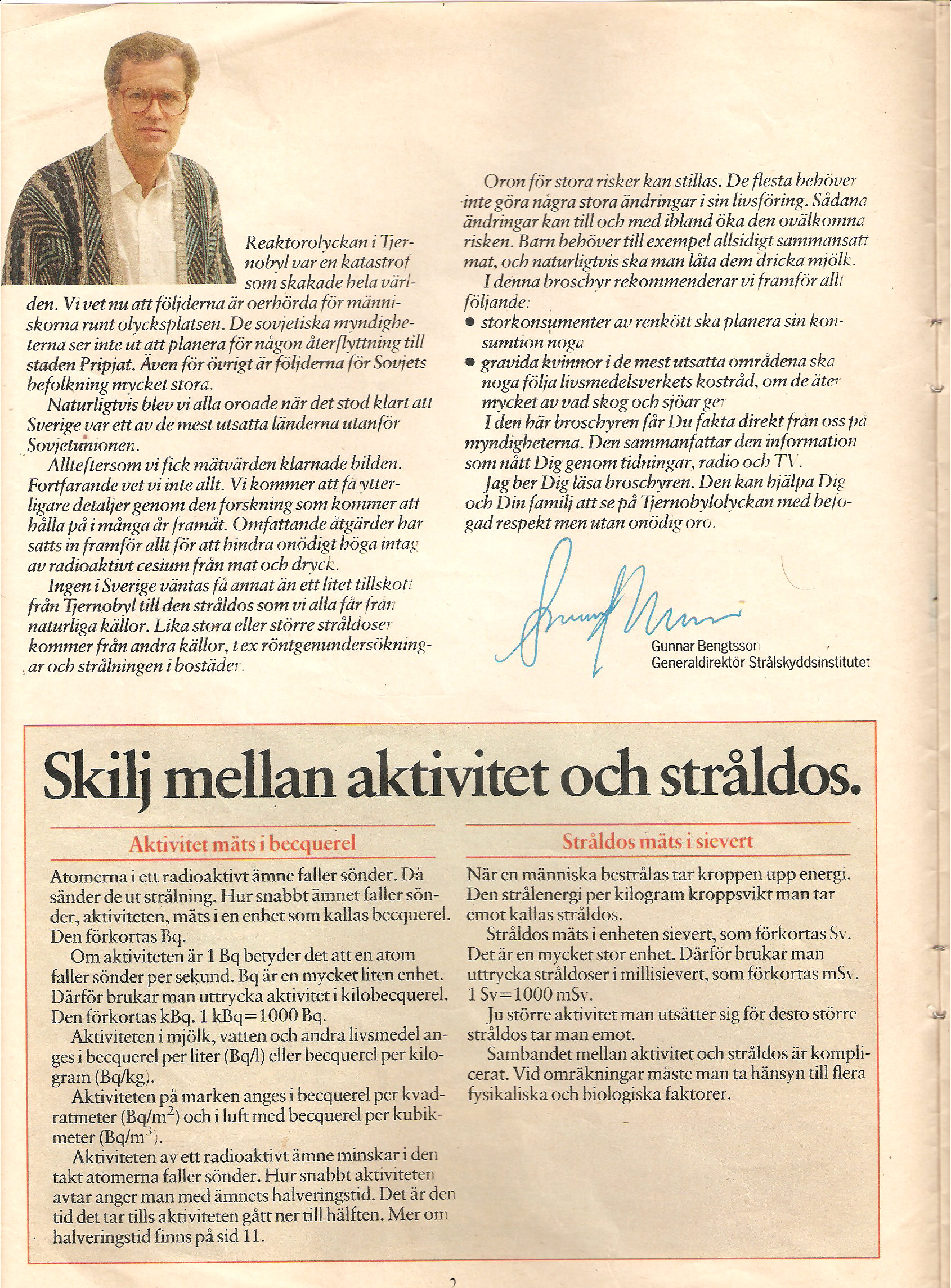


"The reactor accident in Chernobyl was a disaster that shook our entire world. We now know that the consequences for the people located nearby the site. The Soviet government doesn't seem to  be planning to return the evacuees of Pripyat back to their town. Even aside of this, the consequences for the people of the Soviet Union are very large. 
Of course, we were all alarmed, when it appeared as clear, that Sweden was one of the most exposed countries outside the Soviet Union. 
As we received the readings [of radiation], the image cleared. But still, we don't have all the information. We will receive further details through the research that will be performed many years ahead. Comprehensive actions have been taken in order to prevent unnecessarily high ingestion of radioactive caesium from food and drink.
No one in Sweden is expected to receive other than just a little addition, from Chernobyl, to that dose of radiation that we all receive from natural sources. Equal or larger doses come from other sources, such as x-ray examinations and the radiation of houses. 
The worries of big risks can be still. Most people do not have to make any big changes in their ways of life. Big changes may sometimes even increase the unwelcome risk. For example, children need a well composed food intake and of course they should be allowed to drink milk.
In this pamphlet we above all recommend the following:
*Large consumers of reindeer meat shall plan their consumption carefully. 
*Pregnant women in the most exposed areas shall most carefully follow the advice of the NFA, in case of consuming a lot of products from forests and lakes.
In this pamphlet, You get the facts directly from the government. It summarizes the information that has previously reached you through newspapers, radio and TV. 
I ask you to read this pamphlet. It may help You and Your family to look at the Chernobyl disaster with rightful respect, but without unnecessary fear."

These were the printed words of Gunnar Bengtsson, the director-general of the Swedish Radiation Protection Institute. I will not translate all of this 12 pages long pamphlet, but only summarize the content of the pages. Further down on page one, "Differ between activity and dose" you learn how to differ between radioactive activity and received doses: Activity is measured in bequerel (Bq) and received doses in sievert (Sv) [previously the equivalent unit was Roentgen]. The more activity you're exposed to, the higher dose you receive, naturally. Further, the text explain that the coherence between activity and dose is complicated. "Calculating it all, you need to take various physiological and biological factors into consideration."


A summary of the fallout in Sweden; information about the weather conditions of the time of the disaster; the levels of radiation and the attributes of the radioactive elements iodine-131, caesium-137, ctrontium-90 and plutonium-239.  Over Sweden, were spread a few grams of iodine-131, about 1,5 kilograms of caesium (5% of the total caesium fallout) and just a little plutonium. No strontium at all, it seems. Also it's pointed out that. "The five tons of plutonium that were spread throughout our atmosphere during the 50's and 60's, due to nuclear warhead detonations, is completely dominating our share of the Chernobyl fallout". All true, still admitted that radioactive atoms were everywhere. Please note that they were only atoms. 


The question is about whether people may still eat vegetables and drink milk provided in the food stores. A few days after the Chernobyl disaster, the Swedish government recommended farmers to keep their cows indoors in order to protect the cows' milk from getting contaminated by iodine-131.  The government decided on a maximum level regarding how high an amount of caesium-137 is acceptable in food and drink distributed to the public. The bags on the picture make a comparison between the amount of Bq of 2 kilograms of food purchased in Gävle and Malmö and the text inform that in both cases, the radioactivity of the groceries are far below the allowed maximum level. Only if you'd eat a lot of products coming from  of contaminated areas, you should have to restrict your intake of unchecked meat of reindeer, lamb, cheep and moose; a lot of freshwater fish and a lot of mushroom and berries from the forests.

Guidelines for activity in foodstuff

This piece of text explains that the goal of the NFA is to keep the levels of food contamination to an equivalent of a maximum of 1 mSv received per year. 1 mSv gives 75 000 Bq of caesium-137 or 50 000 of the less frequented caesium-134. However, the total received dose is not supposed to exceed 5 mSv per year, so you can see there is quite a margin there. 
Completing information, "Examination of foodstuff" tells about how the process of checking foodstuff was carried out.


Here it's stated that different kinds of foodstuff has absorbed different amounts of radiation. The amounts vary with foods and area and again it is assured that the levels are below the recommended, and repeated that you should not eat a lot of freshwater fish, meat from reindeer, lamb and cheep or mushroom or berries growing in the wild. 

Does it seem like the Swedish government was trying too hard in order to calm the citizens of the country? Actually they didn't try hard enough, because still to this day there are Swedes who fear the Chernobyl fallout. 

This you can do by yourself 

If you're hunter, fisher or someone who likes to collect mushroom and berries from the forest, here's information of where to turn if you're insecure whether your area is safe. 


Shows a chart of how local foodstuff has been affected by radiation. 
Water: nothing significant. Left to right: 

Milk: some of the caesium is transferred to the milk as cows cover large areas when eating grass.

Wild berries and mushroom:  grow on grounds poor of nutrition, are thus more prone to pick up caesium than their fertilized equivalencies.

Plants: meaning crop, potato and vegetables that are growing on fertilized, calcium enriched, grounds only take up a small part of the caesium.

Meat: in some cases levels over the recommended have been discovered. Pigs eat fodder containing a small amount of caesium, thus pigs' meat has low radioactivity. Meat from lamb and cheep from contaminated areas may contain very high amounts of caesium as they feed on growth close to ground surface. 

Reindeer and game: Move around contaminated areas and find their food on similar places as the above. 

"The amount of caesium an animal ingests, will in time be secreted from the body. Half of the amount is gone in 1-2 months. The amount of caesium in an animal is thus determined how much caesium it ingests and how much that is secreted" - And the metabolism plays a role as well, just as for us humans. 

Fish: Sea fish have been affected to a barely notable extent. In lakes and rivers suffering the heaviest fallout, there are locally levels exceeding the recommended. Algae and plankton have taken up radioactive substances. As fish eat these things, and as fish have a very low metabolism, the local problems may thus remain for years.


"In some cases significant amounts of radioactive stuff were collected from the [Chernobyl] fallout, in filters of large airflows, for example in industrial facilities, and large office complexes and housings.
Changing those filters, the normal protection used against dust and small particles is enough in order of protection"
Concerning sludge from sewage treatment facilities, there has been raised levels detected, but you can still work in the sludge for a few hours a day, without any increased threat to your health.

How our health is affected

About how large amounts of radiation may cause cancer damage on fetus and infants, including matter of mutation, but that no one in Sweden has to worry about that. 


Every number that you read is measured in mSv/year.
Shows how much radiation we receive from cosmos and our sun; the natural decay of the ground; our bodies; from radon in houses (!); in hospitals; other artificial sources and... After Chernobyl: The summary is that we in Sweden got an extra 0,3 mSv per year, including the food, which was people's main fear at the time. It also repeats that you may control your intake of foodstuff and thus regulated the amount of the caesium intake. 


Remember that this pamphlet was written and published when there was still not much information concerning the full picture. Please search the tags for more detailed references. 

"According to reports from the Soviet Union, technicians performed an experiment the night between the 25th and 26th of April 1986, at the 4th reactor of Chernobyl. This was due to the yearly inspection of the reactor. As the reactor was on low effect, they performed a test with an electric generator.
Those performing the test violated the safety precautions. Systems normally supposed to stop the reactor is case of error had been disconnected. The result was that they lost control of the reactor.
The reactor went wild and a few moments later, too hot steam had accumulated. The pressure caused the reactor hearth to explode. Explosions destroyed the reactor building. Parts of the destroyed hearth were [by the explosion] launched 1200 meters into the sky. The most of the parts landed close to the reactor. 
Reactors of this type contain graphite. The graphite caught fire. The graphite-fire spread even more radioactive substances to the envornments. Only after ten days the fire and emissions were under control. It's been calculated that a few percents of the total contents of the reactor were committed into the air. The wrecked reactor is currently being covered in concrete. 
According to the Russian investigation of the accident the disaster was caused by several violations of security. The fast and violent was connected to the construction of the reactor. Nuclear Power Plants with reactors of this construction only exist in the Soviet Union. I most other countries, the reactors are confines in buildings of concrete and steel.
The consequences concerning Soviet has been immense. About 30 people have died. Over 200 have been severely damaged by radiation. Circa 135 000 people have been forced to leave their homes. Unknown, whether they'll be able to move back.
The accident will also have long term effects. They're counting on an extra of ten thousands of deaths the coming 50 years."

Map

Shows how the radioactive wind blew through Europe between the 26th oh April and 1st of May 1986.


The RPI and the Swedish Defence Research Agency put up a number of radiation measuring instruments in order to receive  an early image of the damage done. 

More about half life 

Iodine-131: 8 days
Caesium.134: 2 years
Caesium-137: 30 years

The list based on potential threats to Sweden, due to the Chernobyl disaster, which is why they left out information concerning strontium-90 and plutonium-239.
If the summary of this pamphlet has left you with unanswered questions concerning radiation, I recommend that you to read those of my posts posts regarding effects of radiation:   About Radiation Pt1 ARS - Acute Radiation Syndrome1, About Radiation pt 2 - How it may affect the human body and About Radiation; part 3 - Closing up 


Page 12 - Our readiness for nuclear accidents

"The Rescue Services Agency  is leading and developing its services in the entire country, especially in areas where there are nuclear power plants. That is in the counties of Malmö, Kalmar, Halland and Uppsala. Around every Swedish nuclear power plant there is a 12-15 kilometers inner readiness zone. If something happens that causes large emissions of radioactive substances, the population within this zone will be alerted through sirens and telephones.
The sirens give the signal "Important message - listen to the radio". Information concerning what happened and what you're supposed to do should be given by the County Administration in radio P3.
The County Administration is controlling the Rescue Services Agency where the fire brigade, the police, the municipality, health care services and coastguards are included.
The Radiation Protection Institute and the nuclear inspection, that are state regulators, are a part of this orgnisation. They have an educated and trained organization that was the base of activity after Chernobyl.
The signal "Important message-listen to P3!" can be distributed in most cities and towns all over the country.
The signal is tested at 15:00 hrs the first Monday of March, June, September and December.
The accident in Chernobyl has showed that we need to increase our readiness for nuclear accidents in Sweden. Therefore the current readiness organization will be looked over, and a certain amount of readiness for nuclear accidents will be established in all counties. The nationwide radiation measuring system that already exist, will be expanded. There will be international agreements concerning a quick distribution of information, in cases of nuclear accidents."

The grey box on the top right of this last page, tells that the pamphlet is also available in English, German, French, Spanish, Polish, Serbo-Croatian, Greek, Arabic, Italian, Finnish, Turkish, Icelandic, Kurdish, Persian, Romanian, Tigrinya, Hungarian, Vietnamese  and in simplified Swedish.  No Russian? Well, those were the days of the cold war, weren't they. Lastly, on this 12th page, you are informed about where to turn if you have any ideas or questions. 

As you can see, the Swedes had no real reason to worry about the Chernobyl fallout, and thus the initial fear was quickly dealt with. Does it seem like the Swedish government was trying too hard in order to calm the citizens of the country? Actually they didn't try hard enough, because still to this day there are (a luckily enough very small amount of) Swedes who fear the Chernobyl fallout and who obviously feel "violated" by the fact that they had to be scared for a few days in May 1986, something which is shared with a number of Americans, as a small number of radioactive particles were detected in the atmosphere over Northern America. People who have nothing to fear often try to find something to be afraid of, whilst those who indeed have something to fear, tend to endure. 


2011-09-15

New horizons

These days research craves more time and effort then it allows me to write here. Today, I cannot provide you with any articles or news as I'm currently going back in history on many different levels concerning all this. What I can give you is another update of what has recently happened in the process.

Of my exhibition only  a few days remain. On Sunday I'll be dismantling it all. The response this far has been only positive but I am very disappointed concerning the Gothenburg City Library's way of handling things so I am not likely to exhibit there again in this way. 

Anders Markgren, assistant information officer at the Forsmark NPP, did not respond to my message. I will have to phone him.

I have taken the book project into further concideration and have started to look for publishers to support this future part of the over all Chernobyl project. Next week we'll have the annual Book and Library fair here in Gothenburg. It's the largest event in Sweden concerning this area and almost all publishers, major as well as minor will be there exhibiting. And so will I, in matters of hunting for those publishers. My hopes are not too high, but if someone get hooked it's just a bonus because no matter what I'll go through with this. I'm not going comersial; merely trying to raise an interest.

Perhaps joint efforts with a likeminded. The picture has changed.


2011-09-11

Letter from Hans Blix

H. Blix (middle) at the ChNPP in 1987
Regular readers are already aware of the fact that I some time ago decided to contact Hans Blix, the former chairman of IAEA, but those of you who missed out on that part may read about it here.

Last week I finally got around to write that letter I had had in mind since late August. I sent it with regular mail, rather than calling or writing to any official work address in order not to come off as imposing and also in order to make sure to be noticed. A digital message can easily be ignored or forgotten, but these days a nicely articulated, hand made (I cannot say "hand written" as I did use a printer) catches and demands more attention. 

Today I received a reply. Having put down my contact information in matters of residential address, phone number and e-mail address, it was an easy thing for Hans Blix to simply respond by e-mail, and I was happy to receive this message because even though he cannot afford the time nor effort to get into detail with me concerning Chernobyl, he provided me with very useful information and pointers to where to direct further questions. 

Hans Blix wrote to me: 

"I have my hands overflowing with work regarding questions of disarmaments and the future of nuclear power and thus I'm not prepared to aid you..." "...At this point I'm not  involved in the questions concerning the causes or consequences of the accident, only when it comes to the Shelter project..."

The man is admirable. At the age of 84, he's still working and still dedicated to it. 

I will not hide my slight disappointment concerning not getting the opportunity of a thorough Q & A with Hans Blix, but as I didn't expect to get an answer at all but still received a long and elaborate e-mail, I really cannot complain as it's very useful for me and my continued research. It's a push forward. This has made paths branch further and I intend to investigate every stray.

2011-09-08

The Children of Chernobyl - Part II

Let's continue this subject with something quite funny; funny in a very sarcastic way that is, but first some facts.

There are  theories that fetuses in the wombs of women exposed to highered levels of radiation are at the risk of being damaged in a way that causes mental retardation (amongst other defects). Even though I've previously listed is as more or less a known fact in this article, there are still no concrete evidence for such a statement. Being exposed to extreme levels of radiation may cause damage and disturbance to the central nervous system of an adult human but generally receiving highered levels of radiation will not affect the brain of a physically grown up individual as the brain cells eventually cease to divide. However, as it's known that young not fully evolved brains take greater damage from substances such as drugs and alcohol (due to still being vulnerable in the process of development), we can also assume that the brain of a fetus that through its mother is exposed to radiation will take more damage than  its mother. This far it's all correct.

In 2007, an American published report was made concerning 560 000 children born in Sweden between the years of 1983 and 1988,  apparently based on the research of Swedish scientists at the Stockholm University. They assumed that because the academic performance of the children still in uterus during the time of the fallout, "was generally weaker", it must be directly connected to the radioactivity. 

This may all seem logical at a first glance, but studies made on children born after the Hiroshima and Nagasaki bombs show that quite high doses of radiation received are required to cause actually retardation: Of 100 children, as fetuses exposed to 1 Sv (100 R), 40 would turn out mentally retarded, but with lower exposure the risk  decreased. It's assumed that there's even a threshold between 100 and 200 mSv where the risks are eliminated. This is however not yet completely proven, but even if we assume that this is a fact the pregnant women living in the parts of Sweden that received the most downfall, did not receive even close to that much. According to studies made by the Swedish radiation safety authorities, the highest increased doses (received by less than 1000 individuals) were no more than 2 mSv. The major part of the Swedish population (approximately 70%) recieved less than an increased 0,04 mSv in the year of  1986. Adding all this together it's a riddle where the previously mentioned scientists got their results from. It seems to be the same kind of media appealing fraud as the claims of increased rates of cancer cases in Sweden due to the Chernobyl disaster, which has no solid grounds to rest on whatsoever.

This is an example of how angles can be twisted depending on who is taking the picture. In other parts of Europe, the direct oppsite is claimed: There are absolutely no effects on the children.

Next up I'll refute that as well. 

2011-09-07

Correnspondence and Encouraging and Series of Events

 I went back to the library today, to attend the no known exhibition and found a note in the guestbook reading: 

"Awesome you who tell the truth - the way it should be"
This sincerely brought warth to my heart and will be added as fuel to what makes me proceed with my work. 

I've been writing many letters lately.
Encouraging is always also when people take their work seriously.
As mentioned in this post, I very recently found out that there's still a Swedish organisation caring for children of Chernobyl. I choose the word "still" because when I was visting the Ukrainian National Chernobyl Museum in Kiev there were, as a part of the exhibition, brochures in Swedish, encouraging donations for supporting summer camps for Chernobyl children. These pamphlets were from the late 80's and I cannot recall ever having seen anything like that here. Thus, I was happily surprised when the secretary of information at Tjernobylbarnens Vänner sent me a reply to my message this soon. What surprised me is the fact that this organisation is only 6 years old and has nothing to do with what I saw in Kiev, but even more was I pleased to see that there are people who care not out of tradition, but out of their hearts. Every summer since 2005 they have arranged camps for up to 32 Ukrainian children between the ages of 6 and 15, all suffering health consequenses from the Chernobyl disaster.

A Swedish trade is to have a bad conscience and to feel guilty. Or is it rather about big hearts with a certain sense of taking on responsibility? I honestly, don't know, but to mind is brought the efforts of Liutenant Colonel Vladimir Michailovich Maksimchuk.

Vladimir M. Maksimchuk
Maksimchuk was one of the Chernobyl firefighters who attended not at the night of the disaster, but when there again was a large danger at hand. On the 32rd of May in 1986 sources indicate there that another fire had started at the NPP. The fire rapidly approaced the engine room of the 4th reactor, which was full pipes containing hydrogen gas. Again there was a risk of thermal explosion and Vladimir Maksimchuk and his men were sent in to put out the fire. They could only work firve at the time, for no more than ten minutes each, but Maksimchuck himself stayed close to the area for 12 hours. He received more than 7 Sv/Gy of radiation and was later sent to be hospitalized. 

As soon as Vladimir Maksimchuk had begun to recover, he was sent back to duty. In 1989 he lead the extinguishing work at a chemical plant in the Luthianian city Ionave. In spite of being very ill from radiation sickness, Maksimchuk proceeded with his profession until 1994. In April 1994, the Swedish Red Cross offered the already deadly ill Maksimchuk medical treatment and he was to be transfered to Stockholm by helicopter but it was too late. On May 22nd in 1994 another hero of the big disaster died.

I keep asking myself about the reasons for Sweden to have shown such concern for Chernobyl, its victims and children. May it have something to do with the fact that this country was the very one to expose to the world that something wasn't quite as it should? May it be a way of saying that "as we discovered this mess, it's our duty to help cleaning it up"? Or rather because that they actually asked for help? 


Someone once said:

"Yellow and blue and Chernobyl and Poltava entwine Sweden and Ukraine forever" 


I'll resume my research concerning Chernobyl fallout effects on children and also concerning Vladimir Maksimchuk.


2011-08-10

Breaking the news in Sweden - page 6

Here's page 6 refered to in the previous post. As I'm translating it, I notice that they've made some proof reading errors, but I will not correct them here's almost exactly what it reads. Also I find it quote interesting that the sources give different information and no one has corrected them, but questioning Swedish old media will be another issue, some other time. 


Finally I would like to point out the tone of this article and how the insecurity, suspicion and lack of knowledge concerning Soviet and their doings very much reflect the atmophere of that time, that had only just begun closing in to the end of the Cold War

Big nuclear accident in Soviet

By Harald Hamrin,
DN-correspondent

Moscow: The Soviet Union did on the Monday evening officially admit that there's been an accident at a nuclear power plant in Ukraine. No information was however released concerning the time of the accident or concerning the exact extent. 

A message from the official news agency TASS however indirectly reveals that there has been damage to humans related to the accident.  A government commission has been appointed to investigate the cause of the incident, which is the first of its kind that the Soviet Union admits to. 

- There has been an accident at the Chernobyl Nuclear Power Plant, TASS announced with their first short press release, about nine o' clock on the Monday evening, local time. One of the reactors has been damaged.

The Chernobyl nuclear power plant lies 150 kilometers north of Ukraine's capital Kiev.

According to TASS press releases, actions have been taken to eliminate the consequences of the accident.

- Aid will be given to the affected, announced the news agency, that thereby indirectly confessed that the accident has craved victims to some extent.  At the same time TASS announced that a government commission has been appointed, obviously to investigate the cause of the accident.


Patterns

According to experts of the west, at least one serious nuclear accident has happened in Soviet. It concerns a plant near the town of Kystym in the Urals where radioactive leakage appear to have occurred related to an accident in the late 1960's. This has however never been admitted by Soviet officials, and even during the Monday evening, TASS firmly claimed that such accidents did never happen in Soviet.

On the other hand, the official new agency gave a detailed  report concerning nuclear accidents in other countries. Only during 1979, no less than 2300 nuclear accidents happened in the U.S, according to the TASS press release, quoting the American organization "Critical Mass":

- "The prime reasons of the dangerous situation is the bad quality of the reactors and of other types of equipment, as well as insufficient  control of the technical state of the equipment, negligence of the personnel in matters of safety, and insufficient professional training" writes TASS.


No information 

The news agency especially recalls the Harrisburg accident in 1979, and another in Zion, Illinois when 40 000 litres of radioactive water leaked out. 

Nowehere was there to be found, in any of the two messages that TASS sent out on Monday evening, even a hint of when the Chernobyl accident happened. Lacking of official Soviet information concerning this, only thorough and time demanding meteorological studies of wind direction and wind speed, during the coming days, will be able to determine when the accident happened.

In Moscow, experts from the west however tell DN that approximately 24-72 hours should be counted backwards from the time when of the first increased readings of radioactivity were measured in Sweden.

This should mean that the time of the accident was some time between Friday morning and Sunday morning. 


Light Water Damage

The reactor now topical concerning the Chernobyl accident, is a kind of graphite moderated light water reactor. It has an effect on 1000 megaWatt. The Chernobyl nuclear power plant started operate in 1977 and today they have at least four reactors of the same kind operating. A fifth reactor may recently have been brought into operation and yet another reactor is under construction. At all, the Chernobyl NPP will thus be fully equipped with six reactors, with a total output of 6000 megaWatt. 

The Chernobyl reactor is one of the two reactor types that are currently at disposal of the Soviet Union. About 15 graphite moderated light water reactors are estimated to be currently operating in the Soviet Union. The most powerful of these, with an effect on 1500 megaWatt, is situated in Latvia's capital Vilnius. Added to these, are about the same amount of pressurized water reactors.


30 Reactors

The at all approximately 30 reactors currently at Soviet disposal  are gathered in barely twnty nuclear power plants. The major amount of these are situated in the European parts of Soviet, where the power necessities are high  and conventional energy sources are already almost completely emptied. 

Large nuclear power plants, except the already mentioned, are situated in Leningrad on the Kola peninsula, outside Kursk in the southwest of Russia, outside Zaporozye in Ukraine and near Minsk in Belarus.

However, in Siberia, there are new efforts made concerning water power. At the Communist Party's 27th congress of February and March this year, decisions were made concerning further expansion of the Soviet nuclear industry. Amongst other things, it was decided to make further investions in the now unfortunate 1000 megaWatt graphite moderated light water reactors, as the Soviet standard rector. 


Atomic cloud over Sweden

By Micke Jaresand and Bo Westmar

Soviet has faced their Harrisburg, although worse. Most likely, a nuclear meltdown has occured at the nuclear power plant in Chernobyl, north of Kiev, the capital of the Soviet republic of Ukraine. A radioactive cloud, caused by the accident, made the levels of radiation increase in large parts of Scandinavia.

The accident was confirmed by news agency TASS on the Monday evening. It's the first time the Soviet goverment admits a nuclear accident to have occurred. 

The calculations of wind directions that SMHI [Swedish Meteorological and Hydrological Institute] have made, indicates that the accident occurred early during the Saturday.

-The core is heavily damaged. The particles we've found, show that they were exposed to very high temperatures, that can only be reached at nuclear meltdowns, an initiated source tells DN. 

Amongst other elements, they've discovered niobium, lanthanum and neptunium in the fallout.


Leaks  

Differently from the reactor breakdown in Harrisburg, in the U.S, large amounts of radioactivity have leaked from the reactor in Chernobyl. The reason is that the Soviet reactors are lacking of the solid "shell" that for example Swedish reactors are equipped with. 

- The Swedish reactors are constructed for an over pressure equivalent to five Earth atmospheres. These Soviet reactors can barely take any over pressure at all. 

In Chernobyl, in northern Ukraine, there are now three, maybe four, operating reactors, each having an effect on 1000 megaWatt, each of these bigger than the Swedish reactors. 

In the Soviet reactors, the fuel rods are lowered into graphite and cooled by steam under high pressure. The Swedish are water cooled. 

- What can be suspected, is that the cooling channel with fulel rods doesn't work, and that the fuel rods have molten, and thereby maybe also the graphite, a reactor expert tells Dagens Nyheter.

A similar accident happened during the 1950's with a graphite moderated reactor in Windscale, England.

In Soviet, there are similar reactors, also in Leningrad there are four and in Ignalina, Liuthania, there are two operating and two more planned. 

It was early on the Monday morning when the first signs of increased radiation levels were discovered in Sweden. Workers that were passing through the routine controls at inter alia the nuclear power plants of Forsmark and Studsvik, had radioactive particles on their clothes. 

At Forsmark, was first feared a leakage within their own facility, but measurings made contradicted this.


Radioactivity

In Studsvik, thoroughly measuring the radiation, increased levels were measured even on cars' tyres as well as on several employees.  The measuring showed results twice as high as the normal background radiation.

Also at the nuclear power plant of Barsebäck, raised levels of radiation were measured, about 4-5 times the normal readings. 

Measuring the inner city of Stockholm, showed twice the normal readings .

In Helsinki the readings were even higher. Already on the Sunday evening, levels up to six times as high as the normal state were measured.

According to the first measurings, Gotland was the most affected area in Sweden, but on Monday morning, Fårösund was controlled and it showed that readings were not higher than in the rest of eastern Sweden.


Wind   

During the latest days, a steady wind has blown over the country, coming from the south-east,  and already early on the Monday, you could assume that the radioactive fallout come from Soviet. 

- It's not the first time radioactive fallout from Soviet is discovered. The same thing happened three years ago, and also last year. This time, however, it's about significantly higher readings. 

The levels of radioation are higher than those measured during the bomb tests of the 1960's and are similar to the levels of those after the bomb tests in China during the 1970's.

Gunnar Bengtsson at the RPI wants to downplay the risks of the fallout that Sweden is exposed to:

- The radiation isn't even reaching the highest levels [approved at the Swedish nuclear power plants]. People who live in Radon houses are exposed to far more radiation than the levels measured today. 

Late on the Monday evening, the RPI still registered a slow increase of radioactivity in the air and ground. This indicates, they still have a leakage from the damaged reactor in Ukraine.

Evironment and energy minister Birgitta Dahl is pleased about how the Swedish safety organization worked after the alarms of increased radiation levels. 

- Primarily it was about protecting people in Sweden. That's why it was necessary to make sure that the emissions didn't come from a Swedish nuclear power plant, says Birgitta Dahl. 

Birgitta Dahl turned to Hans Blix, the chairman of IAEA, the International Atomic Energy Agency and asked him to ask ambassadors from other countries concerning the fallout. At the same time, the Swedish embassy [in Moscow] sent out the same question [to the Soviet government].

When Moscow confirmed, the [Swedish] embassy had already other questions to follow: 

- We will require detailed information about what has happened.  It's important to get to know the extent of the accident, and whether there's a risk of further emissions, or if it's all over, says Birgitta Dahl. 

The enivronment and energy minister will also repeat a several years old demand that all civilian Soviet nuclear power plants should be put under international surveilance.


The food can be contaminated

Av Roland Gyllander

Of the elements that may be spread throughout our atmosphere and rain down on our environment after nuclear explosions and accidents at nuclear power plants, caesium, iodine and strontium, are the most important.

Through grazing animals, these [elements] may easily contaminate meat and diary products and through our daily intake be stored in the human body, 

Caesium-137 is well know in this coherence, as this element could be traces all over Earth after American hydrogen bomb tests in the 1950's. 

In 1963, shortly before the test ban treaty, very powerful loads were detonated and the consequense was that the , increasedlevels of caesium-137 in Swedish diary milk two years later increased to the highest levels ever measured - a half of a billion parts Curie (1 curie = 3.7 x 10¹⁰ bq). 

The elements now found in Swedish measuring facilities -  iodine, caesium, strontium, ruthenium and molybden -  indicate emissions from a nuclear power plant. 

In Stockholm 1 Bq (bequerel) of iodine [131] was measured per m³ air, which means one decaying iodine atom per second and it's approximately 1% of the levels of 1965. 

The emission levels are currently from a health aspect non significant compared to the ionizing background radiation we are constantly exposed to, partly from kaluim-40, emitted from our own bodies, partly from the cosmic radiation from the sky, and partly from radioactive elements from the bedrock or buildings. 

Radiation damages living cells partly because of that the radiation dicrectly affect the cell functions, partly due to that natural body elements are transformed into poisonous substances. 

The degradation mechanisms may be very complicated, and it's often pointless to try to classify one radioactive isotope as more dangerous as another. 

Plutonium is mostly harmelss at skin contact but deadly to inhale. Some isotopes of iodine have a half life of a few hours but are still concidered as very dangerous as they affect the thyroid glands.


Criticism towards preparedness

*Lacking information
*Insufficient evacuation organization
*Only one geiger counter for measuring radioactivity

The criticism concerning the evacuation from the 600 Forsmark NPP workers, grew as the line grew longer and longer outside the  Norrskedika sports ground, a few kilometers south of Forsmark.
A few minutes past 11:00, speakers asked the employees, consultants and temporary visitors to leave Forsmark and go to Norrskedika. Only the group who are responsible for reactor operations during incidents and breakdowns will remain.


The announcement, lasting for half a minute, promised more information at Norrskedike. Further, that measuring of potential radioactivity would be performend, but the problems began already during evacuation. The road block set up to prevent traffic to Forsmark, also blocked cars from leaving the nuclear power plant.
- We had to wait for at least half an hour by the road block, says Inga Tellander, a temporary visitor from Stockholm.


The radio


When those who were at the nuclear power plant eventually arrived at the assembly point, they received no information whatsoever concerning what had happened. Some in line had radios and could follow the broadcasts from Radio Uppland.


Inside a room at the sports grounds, the workers' outer garments were measured, but no garmets showed any radioactive readings. On the other hand their shoes, measured by smaller geiger counters, did. In those cases the geiger counters reacted, the shoes were decontaminated with water and alcohol.


But because there was only one measuring station set up, it took a long time to perform the control. At least half of all the shoes measured, showed radioactive readings.
- At least twice as high as the normal radiation. It's obvious that the  radiation comes from a reactor of some kind, told Ero Mattilainen, responsible for the measuring and decontamination in Norrskedika.


Irritation


While their shoes were decontaminated, no one was allowed to leave the building. Everyone also had to leave their names and phone numbers in order to be available for contact during the coming 48 hours. But the irritability increased, there was no information explaining why no one could exit the premises.


In Uppsala, the county administration gained knowledge regarding the abnormally high radioactivity, a quarter past eleven. Managed by governor Ingemar Mundsbo, a preparedness organization began to operate. But the preparedness group rather fast notet, that there was not much they could do: The radioactive emissions did not come from Forsmark. At half past three, operation manager Karl-Erik Sandstedt, announced that the operations [at the NPP] would proceed without any restrictions and with full staff. 


The county administration opened up ten telephone lines to be able to keep worried people informed, but only very few calls were received and the population around Forsmark thus took it easy regarding the radioactivity alert.


Left, is however the criticism concerning deficiency of information and organization. And the question: What would have happened if the emissions were caused by a serious failing of one of Forsmark's reactors?