I believe that I may refer to many of you, my readers, as friends that I have not yet met, because according to the Blogger statistics, I can see that many of you are returning to this place and that some of you have even used the information here as a source of reference (this honors me), so I hope that the reason why you keep on coming here is that you find my blog interesting and resourceful, or more important - that you find the topic of Chernobyl interesting.
Should you have any questions on any of the subjects brought up in this blog or anything related to the Chernobyl disaster, please feel free to drop me a line at projekttjernobyl@gmail.com.
Anyway, enough ranting. Let's get down to business.
As I have brought up in previous blog posts, such as in 86.04.26 - 01.23.49, Breaking the News in Sweden, and
Breaking the news in Sweden - page 6, the Chernobyl disaster was initially exposed in Sweden. As the fallout was discovered and charted, it didn't take long for the public to get anxious and frightened of this matter and thus it didn't take very long for those in charge to come out with information about it all. At least it was due to November 1986. In my home, my parents probably took care of the information pamphlet and I don't remember even having a look at it, so I never knew it even existed. About two years ago, a friend actually gave me a copy of that very pamphlet, so after having dedicated my two latest posts to recent events, it's now time for another walk down the memory lane.
Click on the headlines for full sized pictures. If you have a slow connection, please be patient, as the images are pretty large.

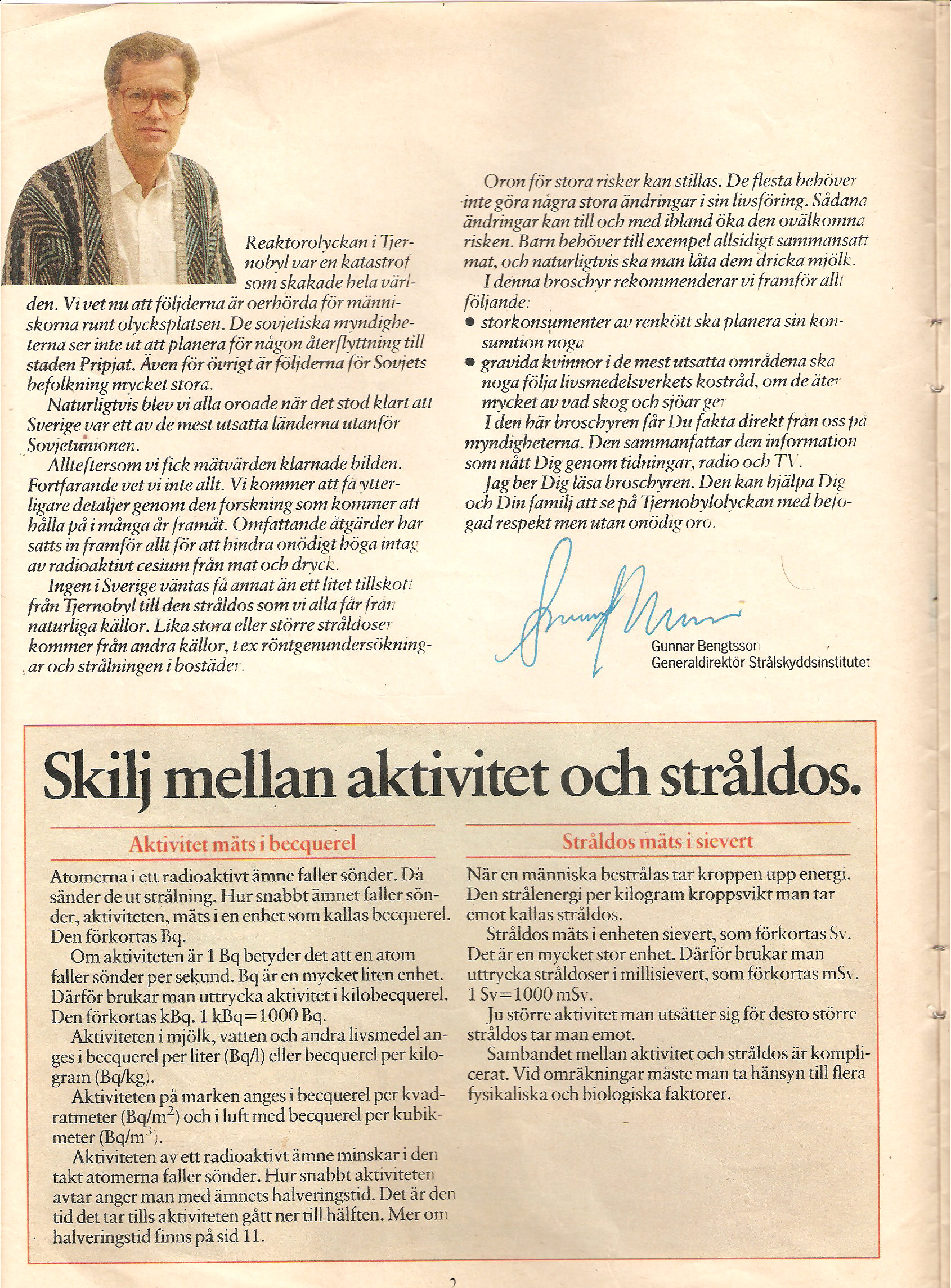
Of course, we were all alarmed, when it appeared as clear, that Sweden was one of the most exposed countries outside the Soviet Union.
As we received the readings [of radiation], the image cleared. But still, we don't have all the information. We will receive further details through the research that will be performed many years ahead. Comprehensive actions have been taken in order to prevent unnecessarily high ingestion of radioactive caesium from food and drink.
No one in Sweden is expected to receive other than just a little addition, from Chernobyl, to that dose of radiation that we all receive from natural sources. Equal or larger doses come from other sources, such as x-ray examinations and the radiation of houses.
The worries of big risks can be still. Most people do not have to make any big changes in their ways of life. Big changes may sometimes even increase the unwelcome risk. For example, children need a well composed food intake and of course they should be allowed to drink milk.
In this pamphlet we above all recommend the following:
*Large consumers of reindeer meat shall plan their consumption carefully.
*Pregnant women in the most exposed areas shall most carefully follow the advice of the NFA, in case of consuming a lot of products from forests and lakes.
In this pamphlet, You get the facts directly from the government. It summarizes the information that has previously reached you through newspapers, radio and TV.
I ask you to read this pamphlet. It may help You and Your family to look at the Chernobyl disaster with rightful respect, but without unnecessary fear."
These were the printed words of Gunnar Bengtsson, the director-general of the Swedish Radiation Protection Institute. I will not translate all of this 12 pages long pamphlet, but only summarize the content of the pages. Further down on page one, "Differ between activity and dose" you learn how to differ between radioactive activity and received doses: Activity is measured in bequerel (Bq) and received doses in sievert (Sv) [previously the equivalent unit was Roentgen]. The more activity you're exposed to, the higher dose you receive, naturally. Further, the text explain that the coherence between activity and dose is complicated. "Calculating it all, you need to take various physiological and biological factors into consideration."


Guidelines for activity in foodstuff
This piece of text explains that the goal of the NFA is to keep the levels of food contamination to an equivalent of a maximum of 1 mSv received per year. 1 mSv gives 75 000 Bq of caesium-137 or 50 000 of the less frequented caesium-134. However, the total received dose is not supposed to exceed 5 mSv per year, so you can see there is quite a margin there.
Completing information, "Examination of foodstuff" tells about how the process of checking foodstuff was carried out.
Page 5 ...even where the fallout was heavy (continued from page 4)

Does it seem like the Swedish government was trying too hard in order to calm the citizens of the country? Actually they didn't try hard enough, because still to this day there are Swedes who fear the Chernobyl fallout.
This you can do by yourself
If you're hunter, fisher or someone who likes to collect mushroom and berries from the forest, here's information of where to turn if you're insecure whether your area is safe.

Water: nothing significant. Left to right:
Milk: some of the caesium is transferred to the milk as cows cover large areas when eating grass.
Wild berries and mushroom: grow on grounds poor of nutrition, are thus more prone to pick up caesium than their fertilized equivalencies.
Plants: meaning crop, potato and vegetables that are growing on fertilized, calcium enriched, grounds only take up a small part of the caesium.
Meat: in some cases levels over the recommended have been discovered. Pigs eat fodder containing a small amount of caesium, thus pigs' meat has low radioactivity. Meat from lamb and cheep from contaminated areas may contain very high amounts of caesium as they feed on growth close to ground surface.
Reindeer and game: Move around contaminated areas and find their food on similar places as the above.
"The amount of caesium an animal ingests, will in time be secreted from the body. Half of the amount is gone in 1-2 months. The amount of caesium in an animal is thus determined how much caesium it ingests and how much that is secreted" - And the metabolism plays a role as well, just as for us humans.
Fish: Sea fish have been affected to a barely notable extent. In lakes and rivers suffering the heaviest fallout, there are locally levels exceeding the recommended. Algae and plankton have taken up radioactive substances. As fish eat these things, and as fish have a very low metabolism, the local problems may thus remain for years.

Changing those filters, the normal protection used against dust and small particles is enough in order of protection"
Concerning sludge from sewage treatment facilities, there has been raised levels detected, but you can still work in the sludge for a few hours a day, without any increased threat to your health.
How our health is affected
About how large amounts of radiation may cause cancer damage on fetus and infants, including matter of mutation, but that no one in Sweden has to worry about that.

Shows how much radiation we receive from cosmos and our sun; the natural decay of the ground; our bodies; from radon in houses (!); in hospitals; other artificial sources and... After Chernobyl: The summary is that we in Sweden got an extra 0,3 mSv per year, including the food, which was people's main fear at the time. It also repeats that you may control your intake of foodstuff and thus regulated the amount of the caesium intake.

"According to reports from the Soviet Union, technicians performed an experiment the night between the 25th and 26th of April 1986, at the 4th reactor of Chernobyl. This was due to the yearly inspection of the reactor. As the reactor was on low effect, they performed a test with an electric generator.
Those performing the test violated the safety precautions. Systems normally supposed to stop the reactor is case of error had been disconnected. The result was that they lost control of the reactor.
The reactor went wild and a few moments later, too hot steam had accumulated. The pressure caused the reactor hearth to explode. Explosions destroyed the reactor building. Parts of the destroyed hearth were [by the explosion] launched 1200 meters into the sky. The most of the parts landed close to the reactor.
Reactors of this type contain graphite. The graphite caught fire. The graphite-fire spread even more radioactive substances to the envornments. Only after ten days the fire and emissions were under control. It's been calculated that a few percents of the total contents of the reactor were committed into the air. The wrecked reactor is currently being covered in concrete.
According to the Russian investigation of the accident the disaster was caused by several violations of security. The fast and violent was connected to the construction of the reactor. Nuclear Power Plants with reactors of this construction only exist in the Soviet Union. I most other countries, the reactors are confines in buildings of concrete and steel.
The consequences concerning Soviet has been immense. About 30 people have died. Over 200 have been severely damaged by radiation. Circa 135 000 people have been forced to leave their homes. Unknown, whether they'll be able to move back.
The accident will also have long term effects. They're counting on an extra of ten thousands of deaths the coming 50 years."
Map
Shows how the radioactive wind blew through Europe between the 26th oh April and 1st of May 1986.

More about half life
Iodine-131: 8 days
Caesium.134: 2 years
Caesium-137: 30 years
The list based on potential threats to Sweden, due to the Chernobyl disaster, which is why they left out information concerning strontium-90 and plutonium-239.
If the summary of this pamphlet has left you with unanswered questions concerning radiation, I recommend that you to read those of my posts posts regarding effects of radiation: About Radiation Pt1 ARS - Acute Radiation Syndrome1, About Radiation pt 2 - How it may affect the human body and About Radiation; part 3 - Closing up
Page 12 - Our readiness for nuclear accidents
 "The Rescue Services Agency is leading and developing its services in the entire country, especially in areas where there are nuclear power plants. That is in the counties of Malmö, Kalmar, Halland and Uppsala. Around every Swedish nuclear power plant there is a 12-15 kilometers inner readiness zone. If something happens that causes large emissions of radioactive substances, the population within this zone will be alerted through sirens and telephones.
The sirens give the signal "Important message - listen to the radio". Information concerning what happened and what you're supposed to do should be given by the County Administration in radio P3.
The County Administration is controlling the Rescue Services Agency where the fire brigade, the police, the municipality, health care services and coastguards are included.
The Radiation Protection Institute and the nuclear inspection, that are state regulators, are a part of this orgnisation. They have an educated and trained organization that was the base of activity after Chernobyl.
The signal "Important message-listen to P3!" can be distributed in most cities and towns all over the country.
The signal is tested at 15:00 hrs the first Monday of March, June, September and December.
The accident in Chernobyl has showed that we need to increase our readiness for nuclear accidents in Sweden. Therefore the current readiness organization will be looked over, and a certain amount of readiness for nuclear accidents will be established in all counties. The nationwide radiation measuring system that already exist, will be expanded. There will be international agreements concerning a quick distribution of information, in cases of nuclear accidents."
The grey box on the top right of this last page, tells that the pamphlet is also available in English, German, French, Spanish, Polish, Serbo-Croatian, Greek, Arabic, Italian, Finnish, Turkish, Icelandic, Kurdish, Persian, Romanian, Tigrinya, Hungarian, Vietnamese and in simplified Swedish. No Russian? Well, those were the days of the cold war, weren't they. Lastly, on this 12th page, you are informed about where to turn if you have any ideas or questions.
As you can see, the Swedes had no real reason to worry about the Chernobyl fallout, and thus the initial fear was quickly dealt with. Does it seem like the Swedish government was trying too hard in order to calm the citizens of the country? Actually they didn't try hard enough, because still to this day there are (a luckily enough very small amount of) Swedes who fear the Chernobyl fallout and who obviously feel "violated" by the fact that they had to be scared for a few days in May 1986, something which is shared with a number of Americans, as a small number of radioactive particles were detected in the atmosphere over Northern America. People who have nothing to fear often try to find something to be afraid of, whilst those who indeed have something to fear, tend to endure.
If the summary of this pamphlet has left you with unanswered questions concerning radiation, I recommend that you to read those of my posts posts regarding effects of radiation: About Radiation Pt1 ARS - Acute Radiation Syndrome1, About Radiation pt 2 - How it may affect the human body and About Radiation; part 3 - Closing up
Page 12 - Our readiness for nuclear accidents
The sirens give the signal "Important message - listen to the radio". Information concerning what happened and what you're supposed to do should be given by the County Administration in radio P3.
The County Administration is controlling the Rescue Services Agency where the fire brigade, the police, the municipality, health care services and coastguards are included.
The Radiation Protection Institute and the nuclear inspection, that are state regulators, are a part of this orgnisation. They have an educated and trained organization that was the base of activity after Chernobyl.
The signal "Important message-listen to P3!" can be distributed in most cities and towns all over the country.
The signal is tested at 15:00 hrs the first Monday of March, June, September and December.
The accident in Chernobyl has showed that we need to increase our readiness for nuclear accidents in Sweden. Therefore the current readiness organization will be looked over, and a certain amount of readiness for nuclear accidents will be established in all counties. The nationwide radiation measuring system that already exist, will be expanded. There will be international agreements concerning a quick distribution of information, in cases of nuclear accidents."
The grey box on the top right of this last page, tells that the pamphlet is also available in English, German, French, Spanish, Polish, Serbo-Croatian, Greek, Arabic, Italian, Finnish, Turkish, Icelandic, Kurdish, Persian, Romanian, Tigrinya, Hungarian, Vietnamese and in simplified Swedish. No Russian? Well, those were the days of the cold war, weren't they. Lastly, on this 12th page, you are informed about where to turn if you have any ideas or questions.
As you can see, the Swedes had no real reason to worry about the Chernobyl fallout, and thus the initial fear was quickly dealt with. Does it seem like the Swedish government was trying too hard in order to calm the citizens of the country? Actually they didn't try hard enough, because still to this day there are (a luckily enough very small amount of) Swedes who fear the Chernobyl fallout and who obviously feel "violated" by the fact that they had to be scared for a few days in May 1986, something which is shared with a number of Americans, as a small number of radioactive particles were detected in the atmosphere over Northern America. People who have nothing to fear often try to find something to be afraid of, whilst those who indeed have something to fear, tend to endure.


