Visar inlägg med etikett Strannik. Visa alla inlägg

2011-07-26

Talking to Aleksandr V. Strannik

I don't want to finish this. Getting to know about Aleksandr Vladimirovich has meant something of depth to me and added another spectra to my views on Chernobyl, the disaster, and the web of facts and stories that surround it all. Getting to know him, means much to me.

Our correspondence will proceed, and I will go on asking questions, but this is likely the last post I'll make for a long while, about his memories and the time he spent at the ChNPP. But I prefer to keep this topic open.

All photos are by A. V Strannik.

"I went there voluntarily, wrote a request to make the journey. From our management, there was a department of 50 people who went to the ChNPP.

There was a sad mood amongst the working liquidators. Not because of the dangers to personal health, but because of that we knew that this country would not be suitable for life for many years to come. The guys working in the "hot zone" received 5 times the salary, but when scoring 25 R [2,5 Sv] or more, which could happen in a day or in an hour, they were put on "clean work"My daily life there, my work, was about decontaminating vehicles and to keep track of the levels of radiation, and sometimes to decide the work of other units.
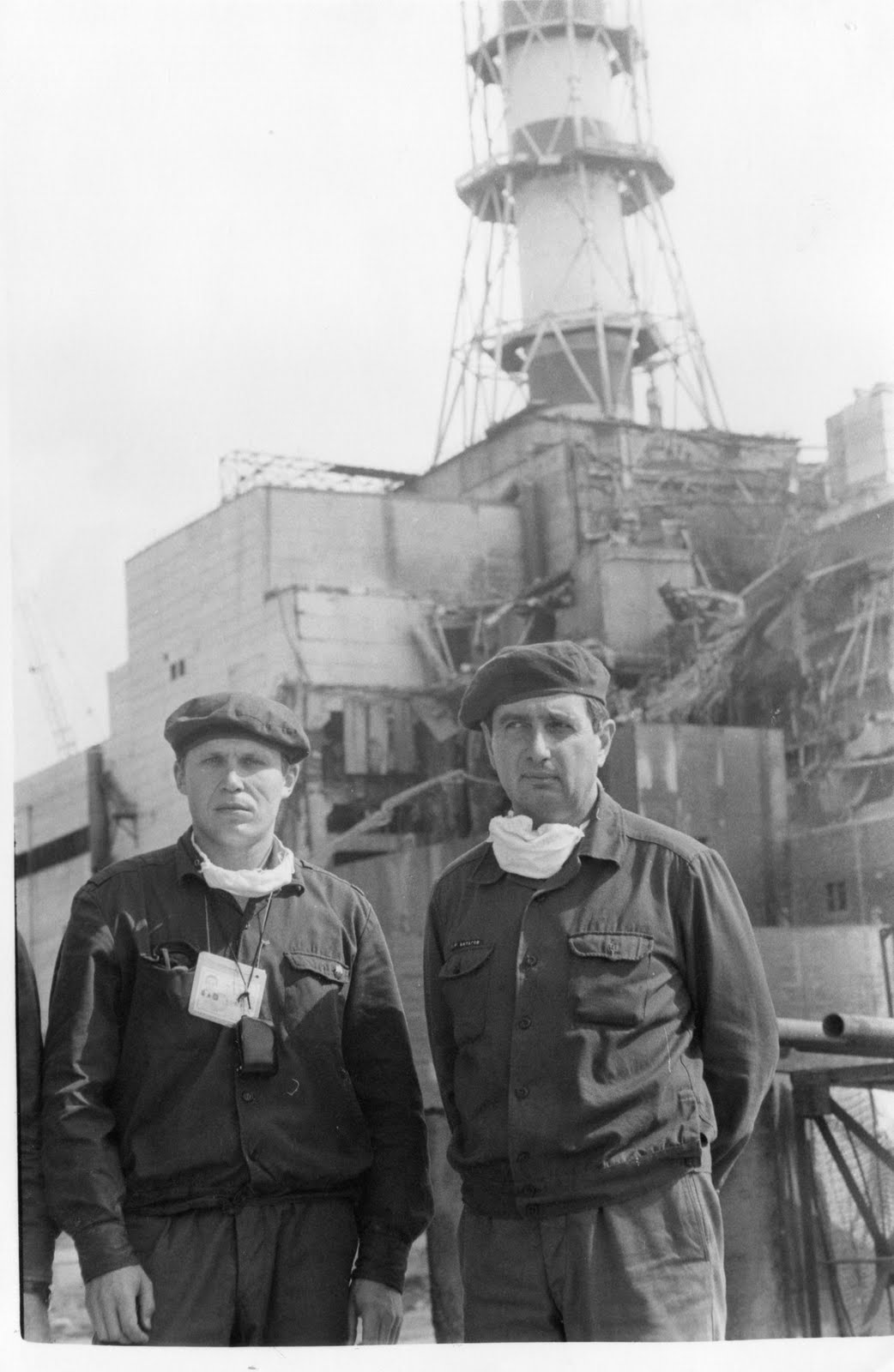
The atmosphere was friendly, when people met, but the communication between different groups [Note: groups of work and profession] was poor. We who were in this group, were engineers and scientists from St. Petersburg (Leningrad). We understood the situation and the circumstances concerning the 4th block and the stories we were told.

There was a careless hurry in removing the shrapnel whilst cleaning the roof [of the 4th block] and with the building of the Sarcophagus. The evacuation of Pripyat went well. No riot police, no victims... But there was the general stupidity of the work organization; the lack of a solid strategy to eliminate the risk of accidents and adapt actions to new circumstances. After what I saw myself, and what I heard from witnesses, I got an appreciation of what was affected - now I know how we fought the second World War.

There was a careless hurry in removing the shrapnel whilst cleaning the roof [of the 4th block] and with the building of the Sarcophagus. The evacuation of Pripyat went well. No riot police, no victims... But there was the general stupidity of the work organization; the lack of a solid strategy to eliminate the risk of accidents and adapt actions to new circumstances. After what I saw myself, and what I heard from witnesses, I got an appreciation of what was affected - now I know how we fought the second World War.When arriving at Chernobyl, I needed to learn the extent of the accident. "What are you going to do here?" asked the boss. "I can shovel debris, like a bulldozer". In August we wished to go on a mission. Request denied. I remember those who wanted to follow; I gathered 5 more people. Curiously enough, the authorities had become lazy as we left, too lazy to alarm. 

Physically as well as mentally, most people I met were normal. But I never met those working in the most dangerous areas. I believe that the most dangerous work was constructing the Sarcophagus and removing the Red Forest in order to clear the area near the site."

After this month of work in the ChNPP, Vladimirovich never returned to Chernobyl.


2011-07-25

The Story of a Photographer and Chernobyl Engineer, part III - Mushrooms

My contact and correspondence with Aleksandr Vladimirovich has increased, and he's come to encourage my work. "It's very good that young people from other countries are interested in the disaster" he told me, wishing me good luck and also offering to try to answer any questions I may have, and yes - as you can probably guess I have a lot of questions, and I have only just begun phrasing and typing down the first of all these questions...

In a hopefully near future you will be able to read the results of this communication. 

Still to this day, people are warned not to pick or consume any mushrooms from Chernobyl or the fallout areas, but Vladimirovich has a different story to tell:

Picking mushrooms in Chernobyl, by A.V Strannik.
"So what about fearing your environments? People are drawn to the exotic, to apples and mushrooms. By now we have good, foreign instruments to measure radiation; the levels of contamination and not just alpha, beta and gamma radiation.

Having measured the levels of radiation from the mushrooms we found, we weren't afraid - it was almost equal to the normal background radiation, only a little higher."

Still, there was a general fear and scepticism agains teating anything growing near the area. But...

"When the mushroom were cleaned, and frying, the scent spread through the room, even the most doubtful came around to taste it; two large portions each and it was all finished."

[Note: The conditions have changed since August 1986. To be on the safe side you should not ingest mushrooms, berries, or any other crop rich on potassium, as potassium is a natural radioactive element in the human body, and also potassium resembles caesium, why mushrooms tend to absorb the latter as well.]


2011-07-22

The Story of a Photographer and Chernobyl Engineer, part II - Alexandr Vladimirovich and Alla Pugachyova.

Alla Pugachyova and Vladimir Kuzmin performing in Zeleniy Mys, 1986.

By the age of 30, Aleksandr Vladimirovich had already participated in photo exhibitions as well as received prizes for his aestethic work, and when going to work at the Chernobyl Nuclear Power Plant, he brought his camera. Here's another fragment of the story of the air purification engineer, whose true passion is depicturing the world around him. 

The Russian mega star Alla Pugachyova was the first artist to perform in Ukraine after the Chernobyl disaster, and Vladimirovich recalls the day of her concert:

"We arrived in our UAP [abbrevation for Ulyanovsk Automobile Plant; УАЗ, Ульяновский автомобильный завод - this is a vehicle] and parked at the fith row. The concert was sold out. The arriving people filled up all space available, and the roofs of their cars - and the roof of our car was all crowded as well. Alla was with Kuzmin [Vladimir Kuzmin, Russian musician], and it was all wonderful. As a curious note, she sang her song "Ask a lady for a dance" [Пригласите даму танцевать] and asked everyone to dance. But nobody danced. Shame on them! Then she pulled up a brave young man, and they danced, but I cannot find any of those photos."

Thousands of Chernobyl victims were listening to Alla Pugachyova that night, on September 8th, 1986, in the small town called Zeleniy Mys [Зеленый Мыс], in the Crimea region. She performed for three hours without seeming to get tired, and there was  a three time encore of her song "Harlequin".
However, this wasn't Pugachyova's first concert in Ukraine that year. In the very summer of 1986, she held a concert n Chernobyl for the liquidators there. But of the food and flowers the star usually received, there was none to give, de to the Chernobyl fallout and contamination. Only alcohol was available; vodka, whiskey and red wine. Witnesses say, that backstage, Pugachyova drank red wine straight from the bottle, to clean her body from Strontium. Most of her audience from that day, are no longer with us.

"Medication for radiation" by A.V Strannik.


Remembering Alla Pugachyova's concert, Vladimirovich also recalls when the first unit left the  Chernobyl central storage in April 1986. "The boys were told 'Who wants to go to the south for a few weeks?' And that's all the got to know - they thought they were going to Crimea. They brought their best clothes; suits, shirts and ties - for going out dancing! Later, I discovered these clothes in the back of the garage. They didn't get them back. My opinion is that this was due to the lack of knowledge of radiation and the general fear of contamination. The next team to make the same journey, left wearing their most poor clothes."


Bottles like the one on the photo on the right, along with a thermos, were sent out to the Chernobyl veterans on the 25th anniversary of the disaster. That, and a framed diploma.


[Note: The unquoted short text about  Pugachyova's Pugachyova's performance is based on my own research and not quoting Aleksandr Vladimirovich. Below: Alla Pugachyova performing in Zeleniy Mys1986]


2011-07-21

The Story of a Photographer and Chernobyl Engineer, part I

A short time ago, I stumbled upon a modest web page with photos of the ChNPP, taken in the summer of 1986. At least so it seemed.

It didn't take me long to trace the photographer, and when so was done, I wrote him an e-mail, asking about the photos.

His name is Aleksandr Vladimirovich Strannik, a man who worked at the ChNPP for one month in the year of 1986 and who loved and still loves photography. These photos is a part of his story and memory of that period of time. On the 19th of April this year, he decided to share his story with the (Russian speaking part of the) world, and my intention is now to pass these further on to you. The text below is partly words from Vladimirovich's journal, and partly from my correspondence with him.

When I told Aleksandr Vladimirovich about my project and showed him my blog, his response was "I see that you're interested in the subject, but me - I was shocked by the accident and the wave of helpless people."

By these words, something suddenly became concrete, and the ordeals and suffering of all these people at last became very clear to me. To read about those who died, those who saved the world and those who still mourn them is real enough, but actually communicating, even if not actually meeting, one of those who were there, and who are still alive carrying the memories, turns it into so much more than being only history.


As 30 years old Aleksandr Vladimirovich came to the Chernobyl NPP in August 1986, to work as an engineer for air purification and dosimetrist, he found that the liquidators had already taken care of the most dangerous cleaning work, and the construction of the Sarcophagus was in full progress. To stop the big threat that the 4th reactor constituted, was top priority at this time, and Vladimirovich, not able to determine whether these men were heroes or just ignorant or careless individuals,  remembers the drivers who transported concrete to the Sarcophagus. They were paid at least 5 times a normal Soviet wage, and were all promised a Lada (car) without having to wait in line for it, when their work was done. Vladimirovich could not know for sure, but he suspected that these men were exposed to at least 20 R/h (2 Sv/h). "This was said to mean one hour of safe work, but it wasn't realistic, regarding the circumstances. Most of them are probably gone by now."


(1) The Sarcophagus under construction.
On this photo (1), you can see the Sarcophagus, concrete transportation/construction vehicles and machines, and the "White box", a booth of lead made to protect the drivers it hid from lethal doses of radiation.


(2)
The Sarcophagus (2): "It was built to protect from new emissions. It wasted money and health." Vladimirovich quotes a line from the magazine Yunost [Юность, means "youth"] on the 20th anniversary of the ChNPP disaster:  "'All the fuel was burnt in the beginning of the process of constructions, for such a protection wasn't needed.' If this theory is correct, then the entire strategy of liquidation was a mistake, as today's project of the Shelter", ad even though typed, the sarcasm in Vladimirovich's words is clearly notable.


Vladimirovich was curious and wanted to take photos of the top of the reactor. Thus he went to the airfield, and there were no security check nor personnel. By the edge of the field stood a trailer, and inside it were all the pilots. 

There were no photos of the pilots.
"Who are you?" asked the pilots. 
"I'm a photographer who wants to see the top of the reactor." 
"Go to the yellow helicopter, they often fly around the block."
"And I went" Vladimirovich tells. "They asked if I was crazy and we were sent back by force. The said they didn't run any business trips for photographers. I took photos of the crew and they asked me when they'd get to see these photos. I told them that I'd develop the photos the same evening and they told me that if I returned the following day, they's fly me over the reactor. I returned when the day was almost through, because I could not come earlier and asked 'Where's the yellow helicopter?' They suspiciously asked me why I wanted to know and I showed them the photos of the guys that I'd brought. 'They promised me a ride over the reactor.' I was told that they had crashed the previous day. The crew was still alive within the walls of a lead sheeted hospital. They who would made an exception and take me on this ride. 'Good luck', they told me, and I passed on the photos of the boys. I was really interested in this flight." 

This is the first part of the story of Aleksandr Vladimirovich Strannik. I won't be able to go on until I've had some more questions answered, so I'm o stand by as much as you are, comrades.